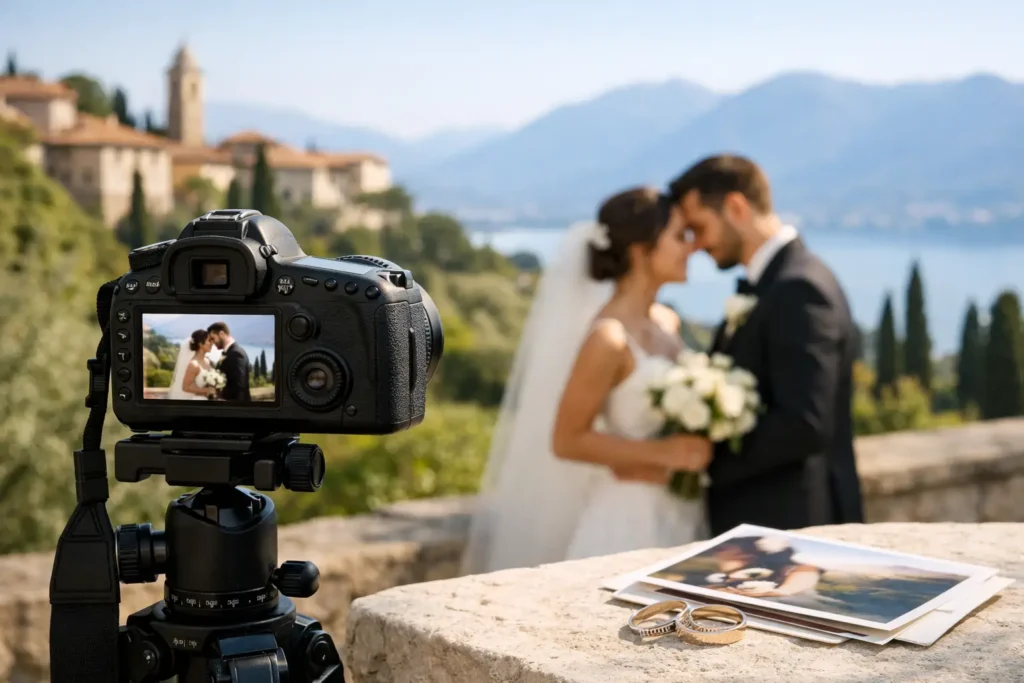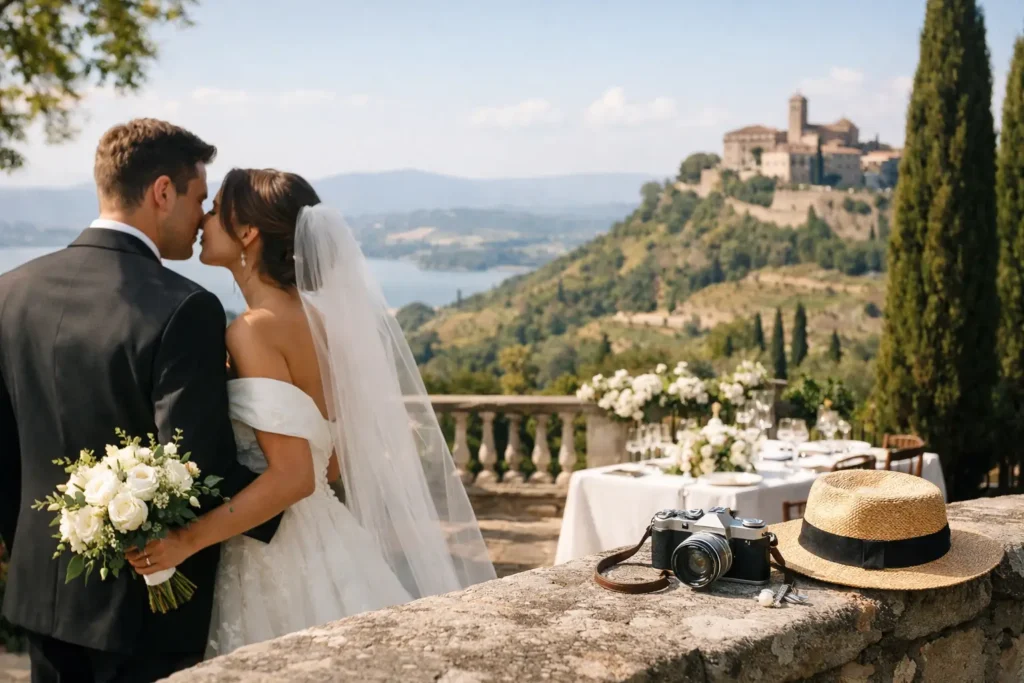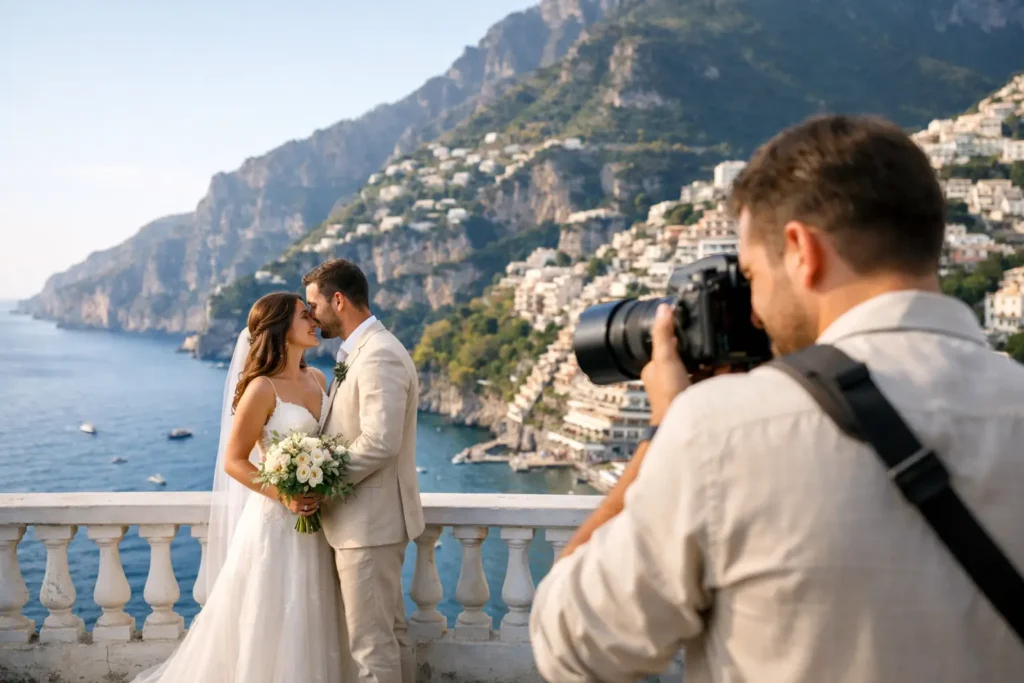
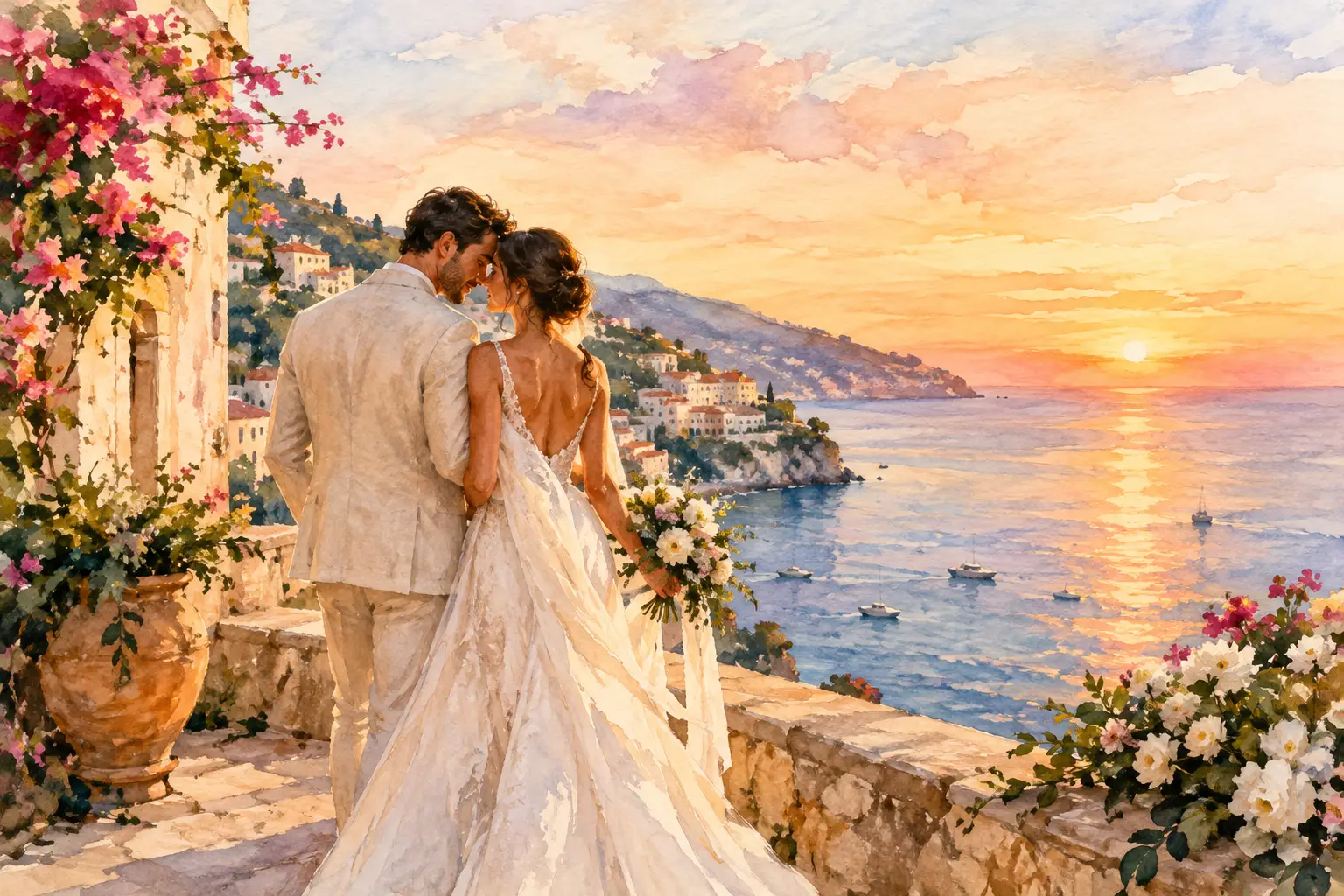
A coastal sunset can change the emotional temperature of a wedding in minutes. Stone warms from pale gray to honey, the sea loses its hard midday glare, and a couple finally has a quiet pause after the ceremony. But using coastal sunset wedding light well is not simply a matter of taking portraits at a pretty hour. On the Amalfi Coast and across Southern Italy, the last light is shaped by cliffs, terraces, narrow streets, sea haze, and a wedding schedule that rarely runs to the minute.
The photographs that feel effortless are usually the result of careful observation and gentle direction. The goal is not to turn sunset into a production. It is to make room for a few unhurried minutes in which the landscape, the light, and the couple’s connection can meet naturally.
Why coastal sunset light needs a different approach
At the coast, sunset is rarely one consistent look. A forecast may say sunset is at 8:15 p.m., yet a terrace in Ravello can fall into shadow much earlier because of its surrounding topography. In Positano, a view toward the water may remain luminous while the lanes and façades behind it are already dark. A small movement of only a few yards can completely change the quality of light on a face.
This is why the best timing depends on the actual setting, not a generic golden-hour calculation. I look for the moment when direct sun becomes flattering rather than harsh, while there is still enough shape and color in the scene. Often, the most refined portraits happen just before the sun disappears behind a ridge or distant horizon, not necessarily at the official sunset time.
There is also a trade-off between the grand view and the most beautiful light. A wide panorama may call for a later moment, when the sky and water carry more color. Intimate portraits beside a textured wall, under an arch, or along a terrace may be stronger ten or fifteen minutes earlier. A considered plan allows for both without pulling a couple away from their guests for too long.
Using coastal sunset wedding light for natural portraits
The most compelling sunset images still begin with people. A dramatic sky can support a photograph, but it should not overwhelm the feeling between two people who have just been married. Rather than asking a couple to hold elaborate poses, I give simple, precise direction: walk slowly toward the view, stay close, take a breath, look at one another before looking at the camera.
This creates movement and leaves space for real expressions. The Mediterranean breeze may lift a veil or the edge of a dress. A groom may instinctively steady his partner on uneven stone. These small gestures are often where the soul of the image lives.
Direction matters more as the light fades. In direct low sun, turning a face slightly can avoid deep shadows around the eyes. Once the light becomes softer, a couple can face each other more freely, with the sea or architecture held as a quieter backdrop. By blue hour, it is often the ambient glow from a hotel terrace, a restaurant, or candles beginning to be lit that adds depth to the frame.
The intention is editorial in finish, but never stiff. A fashion-informed eye helps with posture, line, and composition; a documentary approach keeps the result connected to how the evening actually felt.
Let the landscape frame the moment
Southern Italian coastal towns offer extraordinary natural framing, but each requires restraint. A sweeping Positano view has visual energy already: layered houses, descending cliffs, boats on the water, and changing color across the sky. Here, the couple may need only a clean foreground and a moment of stillness.
In Ravello, the character can be more architectural. A stone balustrade, garden path, or open terrace creates rhythm around the figures. On the Sorrento Coast, the late light can open toward the Bay of Naples, where the horizon gives the composition a calmer, more spacious feeling.
The Cilento Coast offers a different pace. Around Castellabate and Santa Maria di Castellabate, the relationship between historic stone, quieter streets, and the Tyrrhenian Sea can feel beautifully unforced. The setting does not need to be made grander than it is. A small section of sun-worn wall, a view at the end of a lane, or the final light on the shore can say more than a sweeping scene used only for scale.
Build sunset into the wedding day without interrupting it
The most successful sunset portrait session is usually short: often ten to twenty minutes, depending on the location and the flow of the celebration. It should feel like a natural interlude, not an absence everyone notices.
For this reason, timing works best when it is discussed early with the planner or whoever is shaping the schedule. A ceremony that finishes close to sunset can be beautiful, but it leaves little flexibility if family photographs, receiving guests, or a delayed arrival take longer than expected. If portraits are important, a small protected window before dinner is often more valuable than a longer session added optimistically at the end of the day.
A practical approach is to make two portrait windows. The first can happen after the ceremony, when the couple has fresh energy and daylight remains dependable. The second, much shorter window can be reserved for sunset. This means there is no pressure for the final light to carry every portrait, and the couple can enjoy it rather than feeling rushed.
It also helps to choose a nearby location in advance. On the Amalfi Coast, distance can be deceptive. A viewpoint that looks close on a map may require steep stairs, a slow transfer, or a walk through busy pedestrian lanes. Leaving the reception for a distant scene at the precise moment the light is changing is rarely worth the stress. Often the best location is within a minute or two of where the celebration is already happening.
Read the weather, not just the forecast
Coastal weather brings atmosphere, and atmosphere is not the same as perfect sunshine. Thin clouds can soften direct sun and produce a gentle, flattering palette. A hazy evening may reduce the dramatic colors of the sky, yet it can make the sea feel silver and the portraits more intimate. Wind adds movement, but it also asks for thoughtful handling of veils, hair, and lightweight fabrics.
Cloud cover can sometimes extend usable light after the sun is gone. Conversely, a clear evening in a cliffside location can become high-contrast quickly when the sun slips behind the land. Experience is less about forcing a predetermined image and more about recognizing what the day is offering.
When the light changes unexpectedly, the response should be calm. A sheltered doorway, an interior with window light, or a terrace with a softer angle can become the right choice. Couples should never feel that a change in weather means the visual story has been lost. Some of the most cinematic photographs come from the quieter, moodier conditions that cannot be scheduled.
The value of staying through blue hour
Sunset does not end when the sun disappears. The twenty minutes afterward often offer a cooler, more reflective palette, especially when warm artificial lights begin to appear against the deepening blue sky. This is a particularly evocative time for a final walk together, a framed view from a terrace, or a few discreet images as the reception comes alive.
Blue hour requires technical confidence and patience. Skin tones must remain natural, movement needs to feel relaxed, and the atmosphere of the place should be visible without making the photograph look overly lit. It is not the moment for a long sequence of poses. A few carefully observed frames are enough.
For couples planning an Amalfi Coast, Sorrento, or Cilento celebration, sunset is best treated as a living part of the day rather than a fixed photo appointment. Allow a little space for it, stay close to the celebration, and trust the changing light. When the timing is right, you can step away together for a few minutes and return to your guests with photographs that hold both the grandeur of the coast and the closeness of the moment.