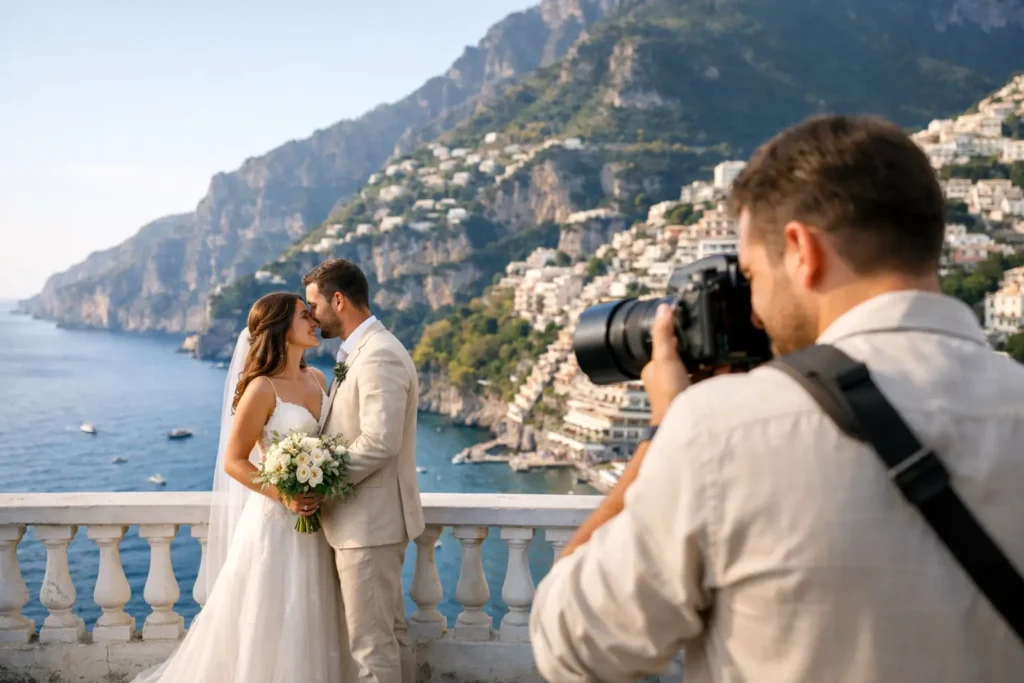
A wedding day in Italy rarely begins when guests take their seats. It begins in the quiet light of a suite in Positano, with a handwritten note being opened, a mother fastening a dress, and the first moment the landscape feels real rather than imagined. Full day wedding photography coverage gives those unrepeatable moments a place in the story, without asking you to watch the clock.
For couples planning a destination celebration, photography is not simply a record of the ceremony. It is the visual thread that joins every feeling, every detail, and every change of light into something lasting. The most compelling wedding galleries do not rush from portrait to portrait. They breathe. They hold space for anticipation, connection, and the beautiful spontaneity that happens between the planned moments.
What Full Day Wedding Photography Coverage Really Means
Full-day coverage is an approach rather than a rigid sequence of hours. It allows your photographer to document the natural arc of the day, from the calm preparations to the energy of the dance floor, while remaining attentive to the moments no timeline can predict.
The morning has its own emotional language. There may be silk robes catching the window light, friends sharing a glass of Champagne, or a father seeing his daughter as a bride for the first time. These photographs become especially meaningful years later because they reveal the atmosphere around you, not only how you looked.
As the day unfolds, coverage makes room for the architectural grandeur of your venue, the ceremony itself, the embraces just afterward, and portraits created when the light is at its most flattering. In Tuscany, that may mean a gentle walk through olive groves as the sun softens. Along Lake Como, it may mean stepping onto a terrace for a few quiet minutes before dinner. There is no need to force the experience. With enough time, portraiture can feel composed yet completely alive.
The story continues long after dinner. Candlelit tables, a spontaneous toast, the movement of your first dance, and the joy on the faces of people who traveled across the world to celebrate with you all deserve the same care as the ceremony. Full-day photography honors the entire emotional rhythm of the celebration.
Why Time Changes the Photographs
Luxury wedding photography is often associated with visual polish, and rightly so. A considered image requires an understanding of light, composition, wardrobe, setting, and gesture. Yet the most elegant pictures also need time. Time is what lets a photographer observe rather than interrupt.
When coverage is brief, every delay can feel consequential. Hair and makeup running late, traffic between locations, a longer receiving line, or simply the desire to stay with your guests can compress the moments that matter. A full day creates breathing room. It protects the experience from becoming a production schedule.
That breathing room is particularly valuable for destination weddings. Italian celebrations often move at a more generous pace: a late ceremony, an aperitivo that becomes one of the day’s liveliest chapters, dinner under the stars, then dancing well into the night. Trying to fit this into a narrow photography window can mean leaving before the atmosphere has reached its peak.
It also allows for a more refined approach to portraits. You do not need to disappear from your guests for an hour. Instead, portraits can be woven into the day in short, intentional intervals: a few minutes after the ceremony, a sunset pause, perhaps another quiet moment once the party has begun. The result feels less posed because you have remained present in your own celebration.
The Chapters Worth Preserving
Every wedding has a different shape, but full-day coverage usually gives proper attention to the details that create a complete visual narrative. This includes the anticipation of getting ready, the ceremony and its immediate emotion, and the celebration that follows.
For destination couples, the in-between scenes are often among the most personal. Your guests arriving by boat, the view from a villa balcony, an uncle laughing during aperitivo, or a table set beneath lemon trees may be part of why you chose Italy in the first place. These are not decorative additions to the gallery. They are the setting in which your memories happened.
A photojournalistic eye is essential here. The goal is not to manufacture emotion, but to recognize it as it unfolds. At the same time, an editorial sensibility gives the day visual cohesion. Thoughtful direction during portraits, an awareness of the venue’s strongest lines, and a fashion-informed instinct for movement can create images that feel cinematic without becoming stiff.
This balance matters. You should look beautifully considered in your photographs, but you should also recognize yourselves in them.
Is Full-Day Coverage Always the Right Choice?
Not necessarily. For a smaller elopement, an intimate city ceremony followed by dinner, or a celebration taking place in one compact location, a shorter collection may reflect the day perfectly. The right coverage should follow the scale and feeling of your plans, not a formula.
Full-day coverage is often the better choice when your wedding has multiple locations, a substantial guest experience, an evening celebration you care deeply about, or a destination itinerary built around the setting. It is also ideal if you value candid photography as much as portraits. Candid moments cannot be scheduled, and a longer presence gives them room to emerge.
Consider what you want to remember beyond the formal milestones. If the answer includes the nervous laughter of the morning, the music during cocktail hour, your guests’ reactions to speeches, and the release of the evening party, then full-day documentation is likely aligned with your vision.
How to Plan a Day That Feels Natural on Camera
The best photography timeline is one that gives you room to be together. Start by protecting a calm morning. Choose a preparation space with natural light and enough room for the people closest to you. Beautiful surroundings help, but emotional ease matters more than perfection.
Plan the ceremony with the light in mind, especially for outdoor venues. A photographer with destination experience can advise on how the sun will move through a terrace, garden, or waterfront setting, helping you avoid harsh midday conditions when possible. That guidance is not about controlling every second. It is about creating the conditions for the day to feel as beautiful as it deserves.
Build in a small portrait window after the ceremony, then reserve another at sunset. Those two moments usually provide everything needed for a varied, artful portrait collection, while leaving the majority of your time open for your guests. If you are having a first look, it can offer another intimate portrait opportunity earlier in the day, though it should be a choice based on what feels true to you rather than a requirement.
Finally, keep the evening in the plan. Reception photographs gain depth as daylight fades and the candles, music, and energy take over. Some of the most soulful images happen when everyone has stopped thinking about the camera.
A More Personal Way to Remember the Day
At Gennaro Piscopo Photography, full-day storytelling is shaped around the people and places that make each celebration singular. Twenty years behind the camera has taught me that the photographs couples return to are rarely only the expected ones. They are the glance before the ceremony, the wind catching a veil, the hands held beneath the table, and the look on a guest’s face during a speech.
A full day gives those moments the attention they deserve. It allows the photography to be both polished and honest, with imagery worthy of an editorial page and a soul that remains entirely your own.
When you look back decades from now, you may remember the grandest scenes first. But the photographs that stay closest often hold the quieter truths: who steadied your hands, who made you laugh, and how it felt to be surrounded by everyone you love as the final song played.