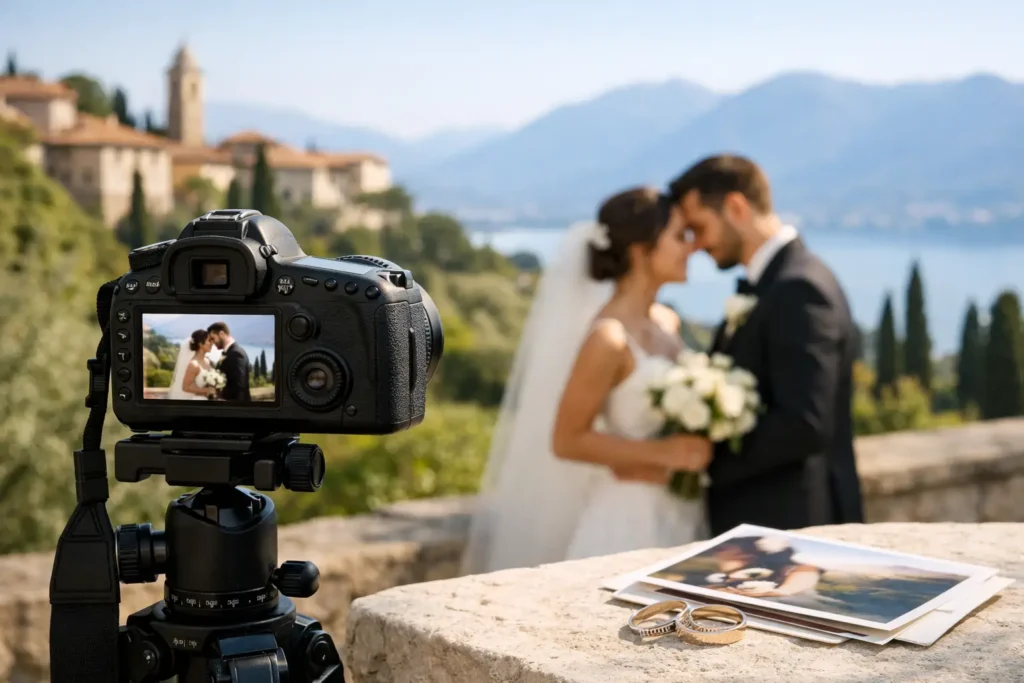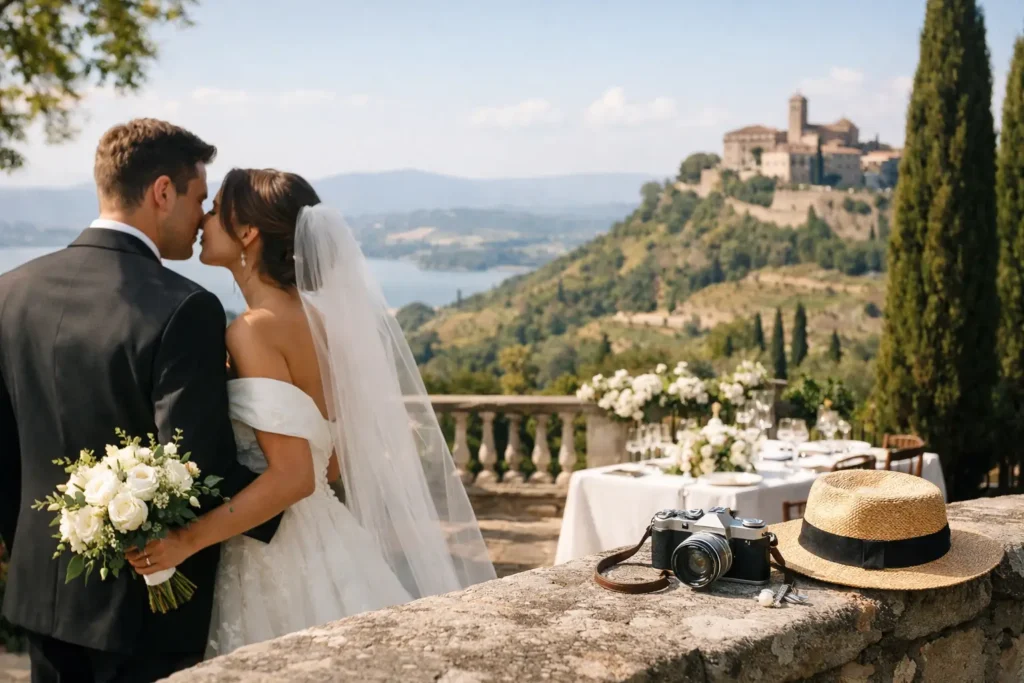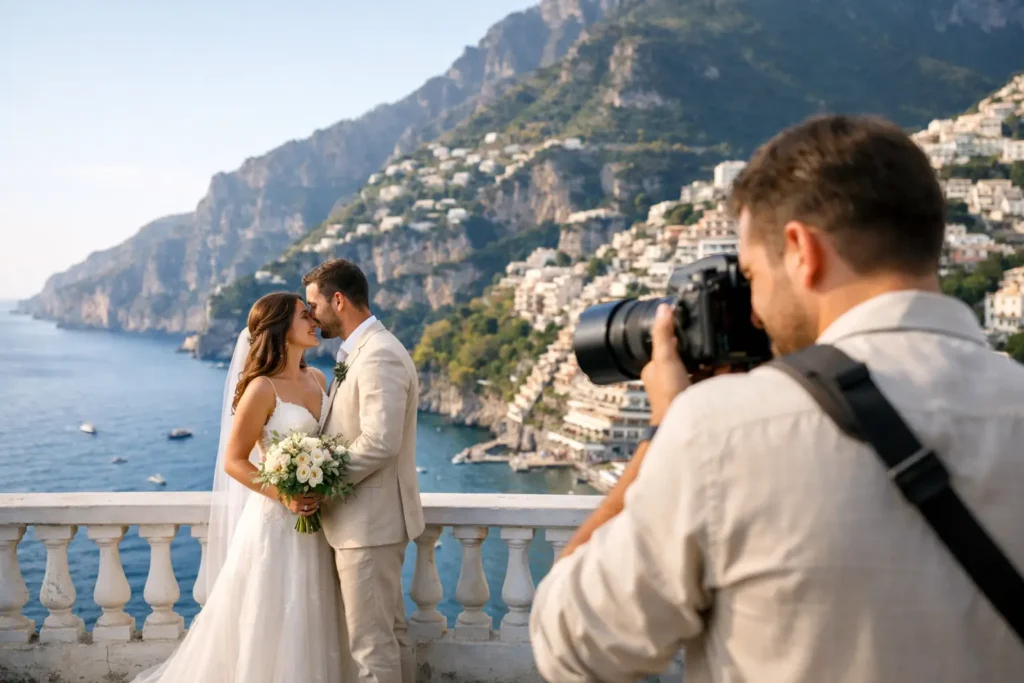
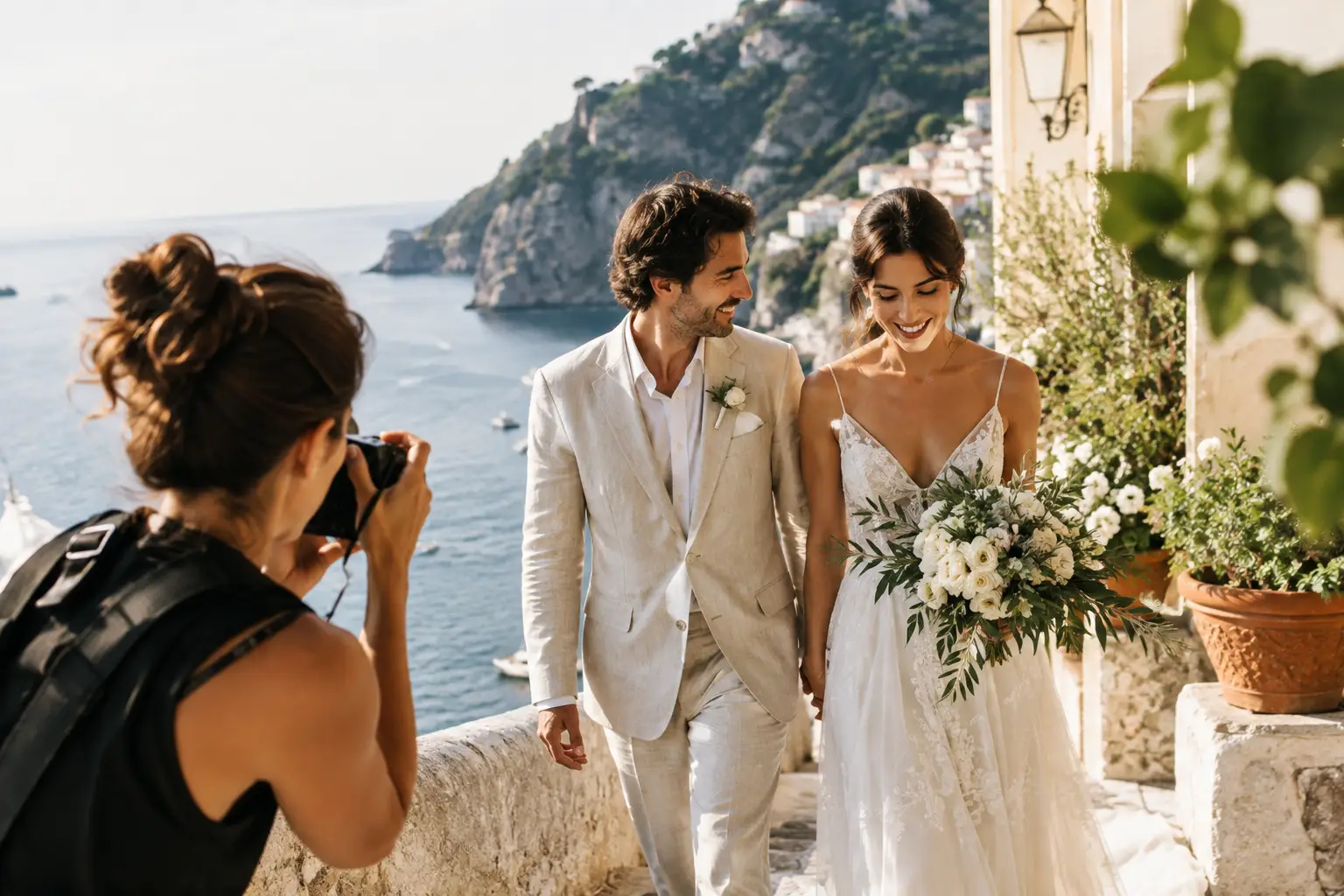
The most revealing photographs of a wedding rarely happen when everyone is looking at the camera. They appear in the seconds between: a father pausing at the doorway, hands finding each other beneath a dinner table, a veil caught by the sea breeze as guests turn toward the music. A documentary wedding photographer works attentively within these fleeting spaces, preserving not only how a celebration looked, but how it moved and felt.
For couples marrying in Southern Italy, this approach has particular resonance. An Amalfi Coast wedding has its own pulse: light shifting quickly across the terraces, narrow lanes filling with arriving guests, the sound of conversation rising over the water. The photographs should honor that atmosphere without interrupting it.
Documentary Photography Is About Presence, Not Absence
Documentary wedding photography is sometimes mistaken for simply taking photographs from a distance. In reality, it requires close observation, anticipation, and an understanding of human rhythm. The photographer is present throughout the day, but never becomes its center.
A quiet approach allows moments to unfold naturally. During preparations, that might mean allowing a bride to share a private exchange with her mother without directing the room. At the ceremony, it means reading the reactions around the vows as carefully as the vows themselves. At dinner, it means recognizing that the image may be found in the candlelight on a guest’s face, the movement of a waiter through the tables, or the warmth of a toast rather than in a posed group.
This does not mean leaving everything to chance. Years of experience create instinct: knowing where to stand before an entrance, when to move before the first embrace, and how to work in a crowded room without changing its energy. The result should feel effortless to the couple, even when the conditions are complex.
Why a Documentary Wedding Photographer Still Gives Direction
The best documentary coverage has room for intention. International couples often want photographs that feel unforced, yet they also appreciate elegant portraits with a sense of place. These needs are not opposites.
A considered portrait session offers a pause within the wedding day. On the Amalfi Coast, it may be a short walk away from the reception as the late-afternoon sun softens against the stone, or a few calm minutes on a terrace after dark, when the coast becomes a field of distant lights. The direction is light and precise: where to stand for the best light, how to move rather than hold a pose, when to look toward each other instead of the lens.
This is where editorial experience matters. A refined image does not require stiffness. It comes from composition, flattering light, and an awareness of how fabric, architecture, and movement work together in the frame. The couple remains themselves, only more at ease because they know they are being guided well.
The balance depends on the day. An intimate elopement may allow more time for portraits and exploration. A large celebration in Positano, where timing and access can be demanding, may call for a faster, more responsive approach. Good planning creates the freedom to be spontaneous.
The Story Is Built From More Than the Major Moments
The ceremony kiss, the first dance, and the cake cutting matter. But they are only part of the visual record. Years later, many couples return to the details that would otherwise have passed unnoticed: a handwritten note resting beside a bouquet, grandparents watching from the shade, friends laughing during the walk to dinner, a child asleep in a chair while the party continues around them.
These photographs give a gallery its soul. They create transitions and context, allowing the final collection to feel like a lived experience rather than a sequence of highlights. The architecture of Ravello, the tiled floors of a historic villa, lemon trees above a Sorrento garden, or the quieter shoreline of the Cilento Coast can all become part of that visual language. They are not treated as scenery alone, but as elements that shape the day.
This is especially valuable for destination weddings. Guests have often traveled across countries and time zones to be there. Their presence is part of the story. A documentary approach makes space for the relationships surrounding the couple, from the formal embraces to the unguarded humor that emerges once dinner begins.
Light, Timing, and the Reality of the Italian Coast
Coastal weddings are beautiful because they are alive to their surroundings. They are also rarely static. Strong midday sun, changing weather, steep pathways, boat schedules, and busy village streets all affect the photographic rhythm of a day.
Local knowledge is not about repeating the same images in every location. It is about understanding how to respond. In Positano, light can disappear behind the mountains earlier than expected in certain seasons. In Ravello, a terrace may be luminous in one direction and deeply shaded in another. Along the Cilento Coast, the atmosphere often feels quieter and more open, with a softer pace that invites a different kind of imagery.
An experienced photographer plans around these realities without making the couple feel managed. The timeline can be shaped to protect time for natural moments, beautiful portraits, and the simple pleasure of being with guests. If the weather shifts, the visual story does not have to lose its character. Rain on stone, wind in a veil, or a sudden change in sky can add texture when approached calmly.
What to Look for in Documentary Wedding Photography
When reviewing a photographer’s work, look beyond individual photographs. A strong portfolio should show complete emotional range. Notice whether the photographer can move from a wide scene to an intimate gesture, from bright afternoon light to a low-lit dinner, without losing consistency or sensitivity.
Look closely at people as well. Do couples appear comfortable? Are guests photographed with dignity and warmth? Is there evidence of honest emotion, not only perfect styling? The most meaningful documentary work is not built around spectacle. It is built around attention.
It is also worth asking how the photographer approaches portraits, family photographs, and the timeline. These conversations reveal whether the experience will suit you. Some couples want only a few quietly directed portraits; others would like a longer editorial session. Neither preference is more correct. The important thing is that the photography feels aligned with the way you want to inhabit your wedding day.
At Gennaro Piscopo Photography, the approach combines unobtrusive observation with carefully shaped portraiture, informed by more than two decades behind the camera and a fashion-photography background. The aim is not to make a wedding look like someone else’s editorial. It is to create images that feel true to the people, the setting, and the atmosphere of that particular day.
Let the Day Breathe
The strongest wedding photographs come from trust. When a couple is free to be present with each other, when the schedule allows breathing room, and when the photographer understands when to step forward and when to disappear, the images carry a different kind of permanence.
As you consider a documentary wedding photographer, spend time with full stories in the portfolio, not just single images. Then use the inquiry page to share the rhythm, location, and feeling you hope for. The right photographic approach will leave you with more than evidence of what happened. It will return you to the people and atmosphere that made the day entirely yours.