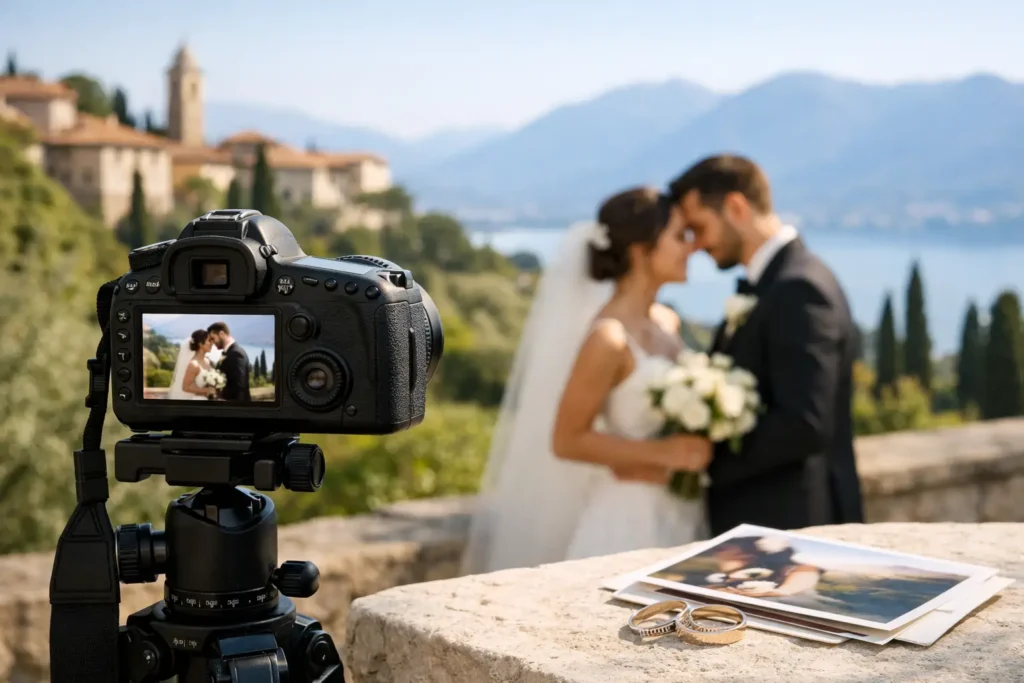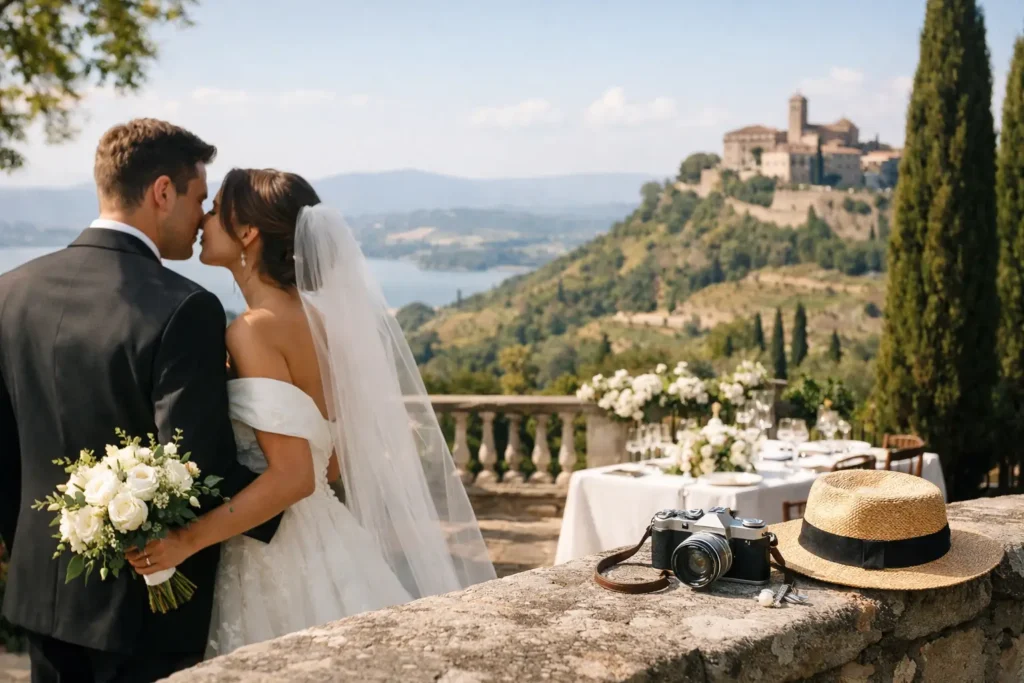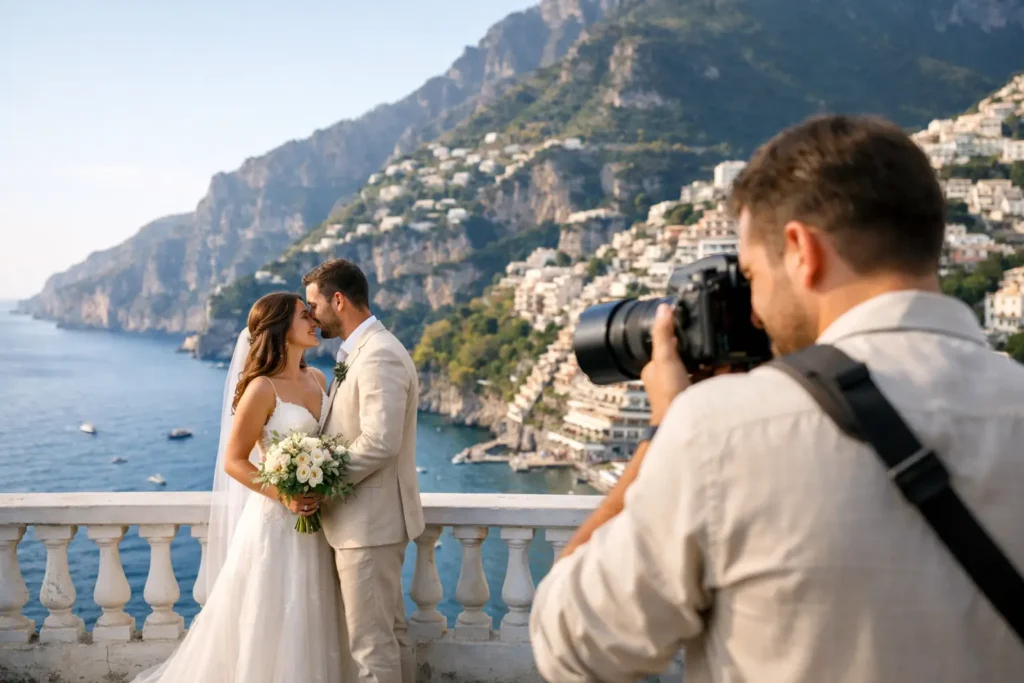
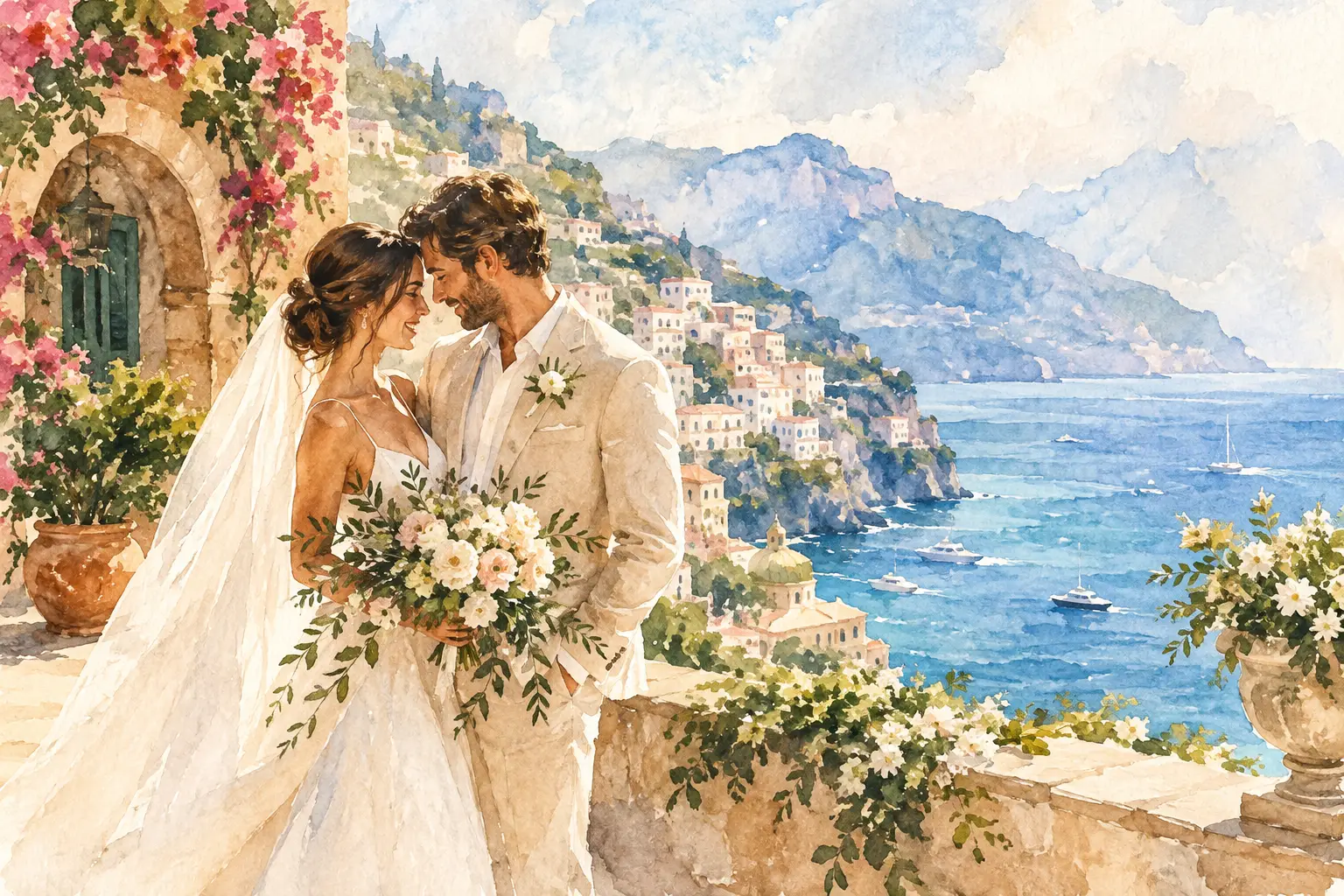
A wedding on the Italian coast is never photographed against a neutral backdrop. In Positano, a ceremony may unfold beneath terraces of fading ochre and bougainvillea. In Ravello, the light can move quietly across old stone before opening toward the sea. In Castellabate, the pace is softer, with pale lanes, olive trees, and a horizon that seems to hold still. Destination photography is the work of recognizing these qualities without allowing the setting to overpower the people within it.
For couples traveling to Southern Italy, photographs need to do more than prove where the celebration took place. They should preserve the anticipation of getting ready in a room filled with Mediterranean light, the pressure of a hand before the ceremony, the rhythm of dinner as daylight slips away, and the faces of the people who crossed continents to be there. The landscape matters deeply, but the story is always human.
What Destination Photography Should Feel Like
The strongest destination wedding photographs have a sense of place and a sense of intimacy at the same time. They carry the color, texture, architecture, and scale of Italy, yet they never feel like a sequence of postcards. A wide frame of the Amalfi Coast has power because it places a couple in their chosen landscape. A close portrait has power because it reveals what that landscape meant to them in that moment.
This balance requires a documentary instinct alongside editorial discipline. Much of a wedding day should be observed rather than directed: a parent adjusting a veil, friends gathering on a terrace, an unplanned laugh during speeches. Those are the frames with soul. Yet there are also moments when thoughtful guidance changes everything, particularly during portraits. A small adjustment of posture, a quieter corner, or a few minutes held back for the final light can create images that feel composed without looking controlled.
My fashion-photography background informs that attention to line, movement, and light, while the approach remains unobtrusive. The goal is not to make a wedding feel like a production. It is to give each part of the day enough space to become visually honest.
The Coastal Conditions That Shape the Images
The Amalfi Coast is beautiful precisely because it is not easy. Its vertical villages, narrow roads, changing weather, and bright reflective surfaces all influence how a wedding day is photographed. Experience here is less about having a fixed formula and more about reading conditions early and making calm decisions as the day evolves.
Light Is Part of the Schedule
Midday light on a coastal terrace can be exceptionally bright. White stone, water, and pale walls reflect it upward, which can be striking but unforgiving for portraits. If the timeline allows, I often suggest reserving the most considered couple portraits for later in the afternoon, when the light becomes more dimensional and the coast takes on warmer, quieter tones.
That does not mean avoiding daytime photographs. A sunlit arrival, a ceremony overlooking the sea, or a walk through Positano’s stepped streets may belong to the visual identity of the day. The decision is about using each hour for what it does best: fresh, graphic daylight for energy and scale; softer evening light for intimacy and depth.
In Ravello, gardens and architectural shade can offer a graceful alternative during brighter hours. Around Sorrento, the geometry of courtyards, shutters, and historic facades can create elegant settings away from direct sun. Along the Cilento Coast, particularly near Castellabate and Santa Maria di Castellabate, the open shoreline and gentler pace invite a different visual language, often more spacious and understated.
Timing Protects More Than Portraits
A well-considered photographic timeline is not about turning the day into a rigid schedule. It protects time for the experiences couples have traveled to Italy for. Without it, portraits can become rushed, family photographs can interrupt the celebration, and the last light may disappear while everyone is still moving between locations.
A useful plan considers practical details that are easy to overlook from abroad: the time needed to walk between spaces, guest arrivals on roads with limited access, the heat of the afternoon, and the way a reception terrace changes after sunset. It also leaves room for real life. A wedding rarely unfolds exactly as planned, and the best photography remains responsive rather than anxious.
Weather Calls for Flexibility, Not Compromise
Coastal weather can change quickly. A passing shower, wind on a high terrace, or haze over the sea does not diminish a wedding story. Often, it gives the images more atmosphere. Soft cloud can be beautiful for skin tones and color; rain can draw everyone closer; wind can bring movement to a veil or dinner linens.
The key is preparation. A photographer should know how to work inside as confidently as outside, find clean backgrounds in limited spaces, and adapt portrait plans without making the couple feel that something has been lost. Weather is not a flaw in the narrative. It is part of the day’s character.
Direction That Still Looks Natural
Many couples are drawn to editorial destination photography but worry that they will feel awkward in front of the camera. That concern is understandable. Most people are not accustomed to being photographed for extended periods, especially on a day that carries so much emotion.
Natural photographs do not require leaving couples entirely alone. They require direction that feels intuitive. During portraits, I may guide you toward better light, suggest where to stand, or offer a simple prompt that creates movement and connection. Then I step back. The space between instructions is where expression returns, where a glance becomes spontaneous, and where images begin to feel like you rather than a pose you were asked to hold.
This is especially valuable in visually busy places. Positano can be full of color, movement, and visitors. A refined portrait is often made not by searching for the grandest view, but by noticing a quiet wall, a framed doorway, or a brief pause on a staircase where the composition becomes simple and the connection becomes clear.
Why Full-Day Storytelling Matters
A destination wedding is rarely only about the ceremony and a short portrait session. Guests may have arrived days earlier. The celebration can begin in the morning with letters, music, and family preparations, then stretch into candlelit dinner and dancing long after the coastline has disappeared into the dark.
Full-day coverage gives the story its proper rhythm. It captures the contrast between private and public moments: the stillness before getting dressed, the energy of the ceremony, the looseness of aperitivo, and the emotion that often emerges during speeches. These chapters are what make an album feel complete years later.
Handcrafted fine-art albums are particularly meaningful for destination celebrations because they turn a temporary gathering into something tactile and lasting. A screen can show a single beautiful image. A well-designed album allows the day to unfold slowly, page by page, with room for landscape, gesture, and the people who gave the celebration its warmth.
Choosing a Photographer Who Knows the Place
When reviewing destination photography, look beyond a few strong portraits. Study full wedding stories. Notice whether the photographer can handle bright sun and low light, large scenes and quiet emotion, formal family photographs and unplanned moments. Look for consistency in skin tones, color, composition, and feeling.
Local knowledge matters, but it should serve the experience rather than dominate it. It means knowing when the light falls behind a hillside, understanding that a scenic route may take longer than expected, and finding calm within a busy coastal setting. It also means respecting the places where people live, marry, and gather.
At Gennaro Piscopo Photography, every wedding is approached as a story shaped by its people, its setting, and the particular light of the day. Before making an inquiry, spend time with the full portfolio stories that resonate with you. The images that stay with you are often the clearest indication of the kind of experience and visual memory you want to create.