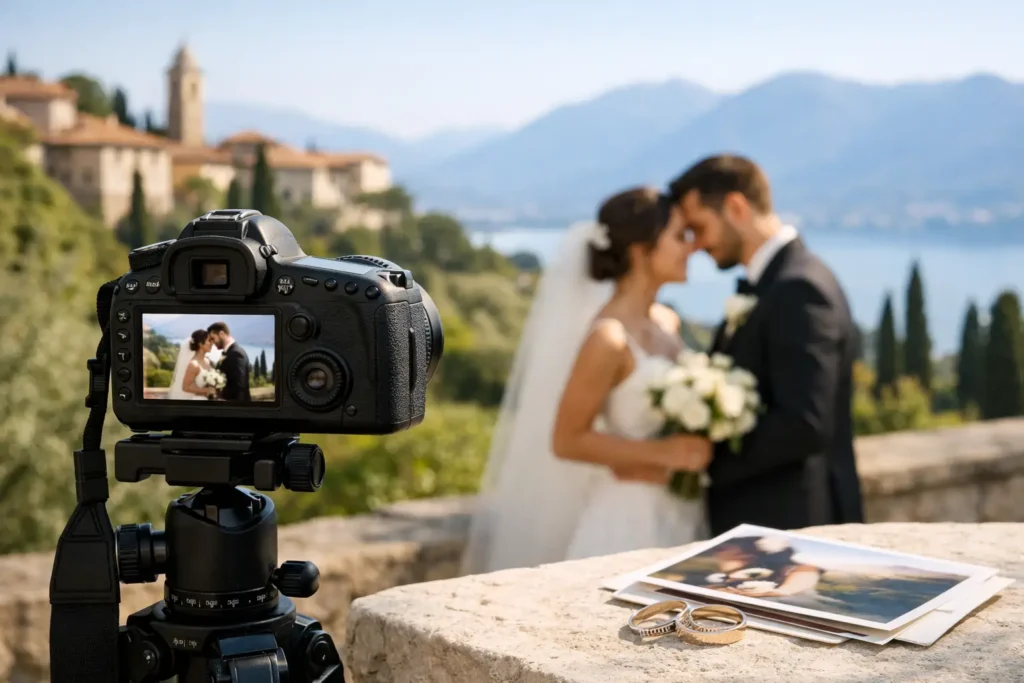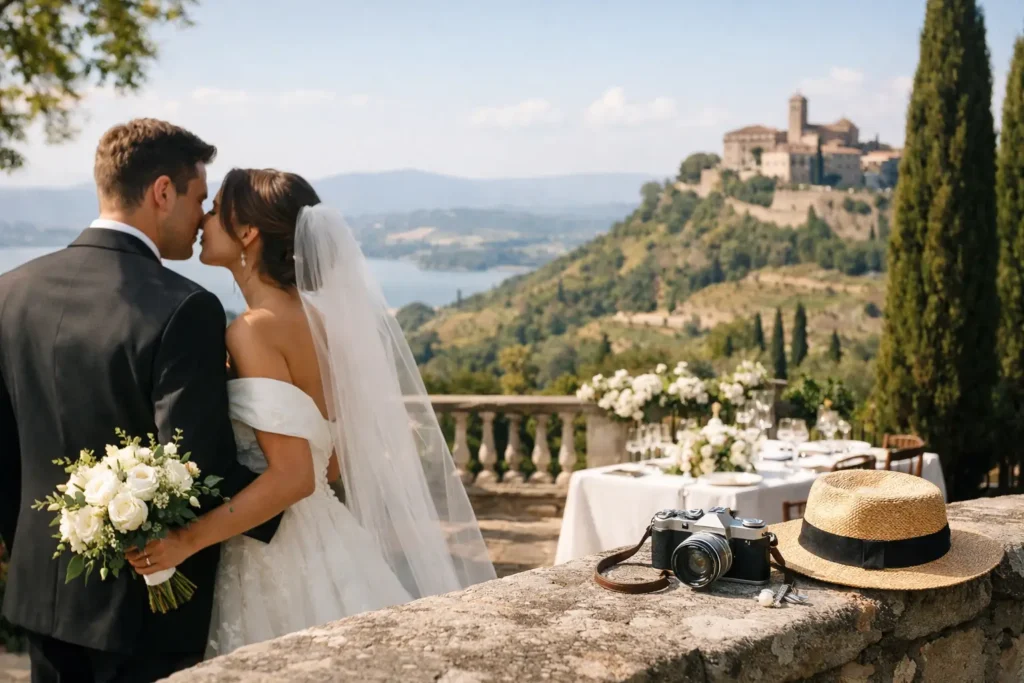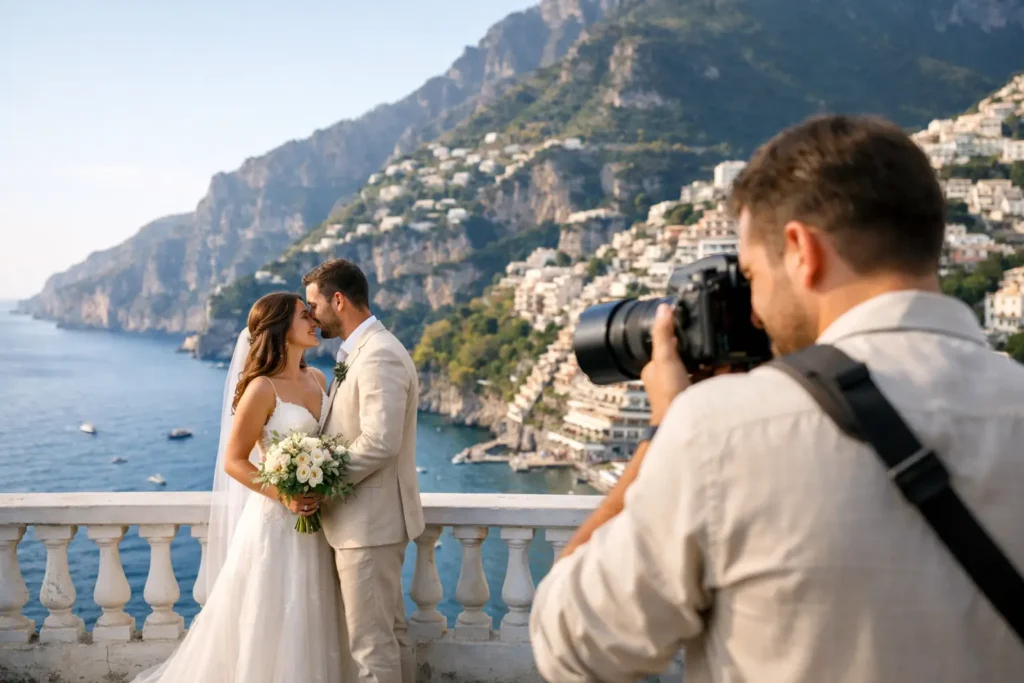
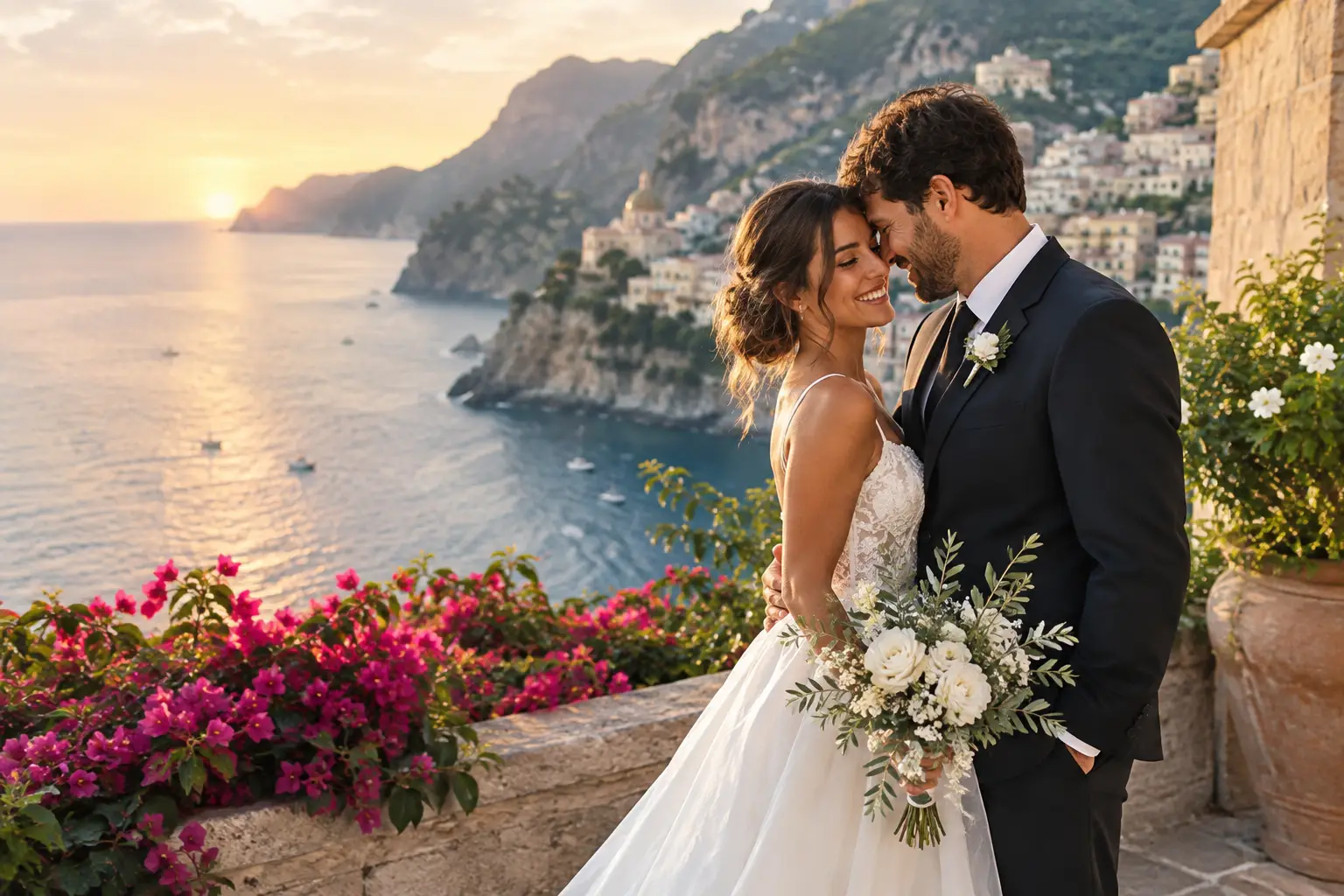
A Positano terrace at noon can be dazzling – white stone, reflective sea, and a sky with almost no softness in it. Two hours later, that same view begins to settle into color and shape. This is why the best time for wedding photos in Italy is rarely a single hour on a schedule. It is a conversation between the season, the architecture, the coast, and the way you want your wedding to feel in photographs.
For couples planning an elegant celebration in Southern Italy, light should not dictate the entire day. But when the timeline respects it, photographs gain a quieter confidence: skin looks luminous rather than overlit, landscapes feel dimensional, and portraits carry the relaxed intimacy that cannot be rushed.
The best time for wedding photos in Italy is usually near sunset
On the Amalfi Coast, the most flattering portrait light often arrives in the final 90 minutes before sunset. The hard Mediterranean brightness eases, shadows lengthen across old facades, and the sea takes on deeper shades of blue and silver. In Ravello, this can create a gentle glow against garden walls and distant coastline. In Positano, it softens the layers of pastel buildings climbing the hillside.
This is often called golden hour, but the phrase can be misleading. It is not a guarantee of glowing, sun-drenched images. A mountain ridge, a hotel terrace, or the narrow geometry of a coastal street can put a location into shade well before the official sunset. In many parts of Positano and Amalfi, the sun disappears behind the landscape earlier than couples expect. An experienced local photographer plans around the actual light at the venue and the route between moments, not only an app on a phone.
The ideal approach is to reserve a protected pocket of time before dinner – usually 20 to 35 minutes is enough – for couple portraits. It should feel like a brief exhale, not a formal interruption. You step away from the celebration, move with ease, and return to your guests before the evening loses its rhythm.
Why midday is not always a problem
Italian weddings often begin in the early afternoon, especially when a ceremony takes place outdoors. From late spring through early fall, midday sun can be strong, particularly along the Amalfi and Sorrento Coasts. It produces bright highlights, deep shadows, and heat that asks more of everyone.
Still, avoiding midday photography altogether is neither realistic nor necessary. A wedding day is a story, not a sunset portrait session. Preparations, the ceremony, embraces after the vows, and the energy of an aperitivo happen when they happen. The work is to photograph them thoughtfully.
At midday, I look for open shade, covered loggias, textured interior rooms, terraces with a soft reflected light, and narrow lanes where the light is directional rather than overhead. A whitewashed wall can bounce light beautifully onto a face. A window can create a composed, editorial frame for a quiet getting-ready moment. For group photographs, even shade and a clear, uncluttered background matter more than forcing everyone into full sun with a view behind them.
The trade-off is simple: midday offers crisp color, vivid atmosphere, and the honest energy of the day, but it is less forgiving for unhurried portraits. Build in shade when possible, then save the most intimate couple images for later.
Seasonal light changes the feeling of the photographs
Spring: fresh color and gentler temperatures
April, May, and early June can be beautiful for wedding photography in Campania. The landscape is green, gardens have life, and daylight stretches later as the season moves forward. The air is often more comfortable than high summer, which makes a longer walk for portraits or a pre-wedding session feel easier.
Spring weather, however, can be changeable. A passing shower is not necessarily a disappointment. Overcast skies create soft, even light that is exceptionally kind to skin, while wet stone and sea air can add a cinematic mood. The key is a flexible timeline and the confidence to use the setting as it is, rather than waiting for a version of Italy that may not arrive on command.
High summer: long days, vivid energy, and careful timing
June through August brings the luminous intensity many couples imagine when they picture the Italian coast. Days are long, evenings stay warm, and outdoor dinners can continue late into the night. It is an extraordinary season for celebrations, but it rewards good planning.
In July and August, schedule the ceremony later if your venue and guest experience allow it. A late-afternoon ceremony reduces heat, protects the comfort of guests in formal attire, and naturally places post-ceremony portraits closer to more forgiving light. A first look can also be useful, not because it must be part of every wedding, but because it creates a private moment and gives the day more breathing room.
Summer towns are busy, too. Positano in particular requires realistic allowances for stairs, traffic, boats, and people moving through public spaces. Privacy in photographs comes less from expecting an empty town and more from choosing angles, timing short portrait sessions intelligently, and staying calm within the movement of the place.
Early fall: warmth with a softer pace
September and early October are often among the most balanced months for an Italian wedding. The sea retains its warmth, afternoons are less severe, and the evening light develops a deeper, more amber quality. For many international couples, this is a compelling balance between summer atmosphere and a more relaxed physical pace.
Sunset comes earlier than it does in midsummer, so the timeline needs adjusting. The advantage is that you can have portraits, dinner, and dancing without asking guests to wait until very late for the evening to begin.
Late fall and winter: intimacy over certainty
From late October through March, the coast becomes quieter and more introspective. Light can be exquisitely soft, the palette more muted, and the experience more private. This season suits elopements, intimate celebrations, and couples drawn to atmosphere over predictable blue skies.
The compromise is shorter daylight and a greater chance of rain or wind. Plan a meaningful indoor alternative, whether that is a room with character, an architectural corridor, or a covered terrace. These are not backup images. In the right setting, they can become some of the most personal photographs of the day.
Build a timeline around people, not only light
The strongest wedding photographs come from a day that allows real connection to remain visible. If every minute is allocated to moving from one view to the next, people begin to feel managed rather than present. A beautiful timeline protects the emotional tempo of the wedding.
Start with the ceremony time, then work backward to preparations and forward to aperitivo, portraits, dinner, and evening celebrations. Allow extra time for coastal travel, especially between separate preparation locations and venues. On the Amalfi Coast, ten minutes on a map can become considerably longer in reality. In quieter parts of the Cilento Coast, such as Castellabate or Santa Maria di Castellabate, the pace may be more forgiving, yet the roads and changing coastal light still deserve respect.
If sunset portraits matter to you, tell your planner and photographer early. There is usually a graceful solution: a slightly later ceremony, a concise family-photo plan, or a short return outside between courses. The intention is not to manufacture images. It is to give your photographs the time and space to hold both the grandeur of the setting and the soul of the people within it.
Do not skip the blue hour
The minutes after sunset are often overlooked. During blue hour, the sky turns cool and saturated while candles, lanterns, and interior light begin to glow. On a Ravello terrace or beside the water in Sorrento, this transition can feel particularly cinematic.
It is also brief. You do not need to leave your guests for long – often five or ten minutes is enough for a few composed images before dinner or after the first courses. This is a wonderful time for photographs that feel less like daytime travel imagery and more like the beginning of an Italian evening.
Let the weather become part of the story
No photographer can promise sunlight, and no couple should carry the burden of trying to control the forecast. What matters is preparation: clear umbrellas that do not distract from the scene, covered options for key moments, extra travel time, and a team willing to adapt without making weather the center of the day.
Clouds can give coastal views depth. Wind can bring movement to a veil or dress. Rain can draw everyone closer beneath a terrace and make the celebration feel unexpectedly intimate. The images that endure tend to be the ones where the couple stayed with each other, rather than with the conditions.
When choosing the timing for your wedding, consider the kind of atmosphere you want as much as the calendar. Then share your plans, priorities, and venue with a photographer who understands how Southern Italian light actually moves. You can explore Gennaro Piscopo Photography’s portfolio for a sense of that visual approach, and make an inquiry early enough to shape a timeline with calm, care, and room for the day to unfold naturally.