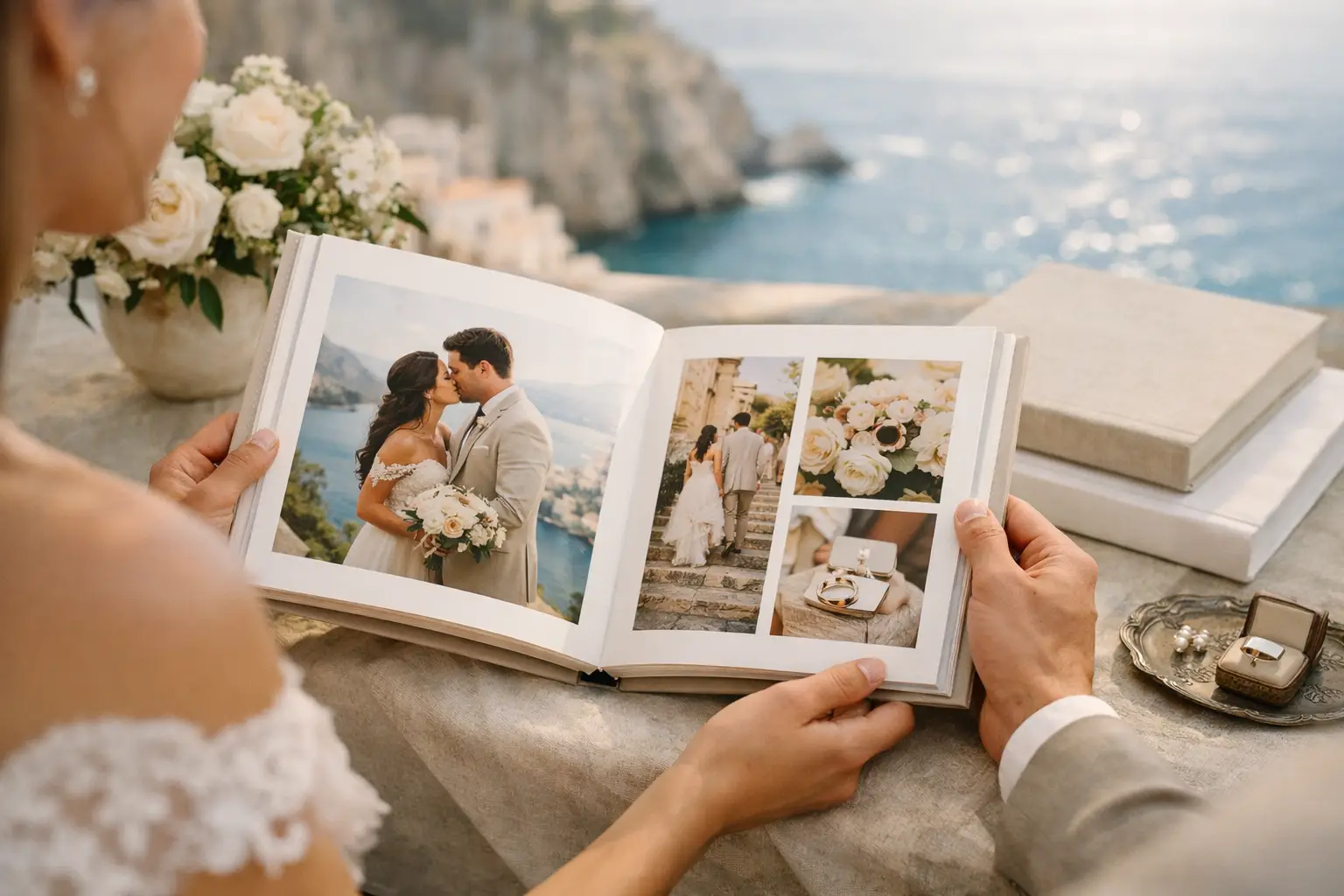
A wedding album should not feel like a smaller version of your online gallery. It should feel more deliberate: a physical story with weight, rhythm, and the quiet intimacy that comes from turning pages together years later. If you are wondering how to choose a wedding album, begin with one question: which images will bring you back to the feeling of being there, not simply remind you what happened?
For a celebration on the Amalfi Coast or in the softer, more secluded landscapes of Cilento, that distinction matters. The salt air beyond a terrace in Ravello, the geometry of a Positano staircase, candlelight falling across a dinner table, a parent’s expression just before the ceremony – these moments need space. A fine-art album is where the atmosphere of the day becomes tangible.
How to Choose a Wedding Album That Tells a Story
The strongest albums are not built around a list of expected photographs. They are designed as a narrative, beginning with anticipation and moving naturally through ceremony, celebration, and the quieter moments in between. A striking portrait deserves its place, but so does the hand fastening a cufflink, the sweep of your ceremony setting before guests arrive, or the laughter that follows a speech.
When selecting images, look for emotional range rather than visual repetition. Ten beautiful portraits taken within the same five minutes may each work in a gallery, but an album often needs one or two. The remaining pages can make room for context: the landscape, family connections, movement, gestures, and details that reveal the character of the celebration.
A considered sequence usually moves from broad to intimate. An opening spread might establish the location and the morning’s stillness. Later, a close portrait, a hand held during the vows, or a spontaneous glance can slow the pace. The energy rises through cocktail hour and dinner, then gives way to the release of the dance floor. This variation is what makes an album feel cinematic rather than chronological in the most literal sense.
Start with the photographs that carry emotion
Begin by marking the images that make you pause. Not necessarily the photographs in which everything looks most polished, but the ones that hold a true response. Perhaps it is your expression as you see each other for the first time, the wind moving through a veil on a coastal terrace, or the people closest to you caught without performance.
Then consider what those photographs need around them. A powerful image often becomes more meaningful when paired with a quieter frame from the same part of the day. The result is not simply a collection of highlights. It is a story with breath and soul.
Choose the Right Size for How You Will Live With It
Album size is a practical decision, but it also shapes the experience of the photographs. A larger format gives architectural views, fashion-led portraits, and full-page landscapes their proper presence. This can be especially compelling for weddings where the setting is integral to the story, whether that is the layered coastline around Amalfi or the warm stone and open horizons near Paestum.
A more compact album feels intimate and easy to revisit. It may suit an elopement, a multi-day celebration with a restrained visual approach, or couples who want an album to live close at hand rather than as a statement piece on a table. Neither choice is inherently better. Think about where it will be kept, who will look through it, and whether you are drawn to grandeur or closeness.
For most full wedding days, a generous but not oversized format allows the design to remain elegant. Images have room to breathe without every spread becoming a dramatic visual display. Scale should support the story, not overpower it.
Let the cover feel connected to your aesthetic
The cover is the first tactile impression of your album, and materials matter. Linen has a quiet, timeless character and works beautifully with celebrations that feel natural, Mediterranean, or understated. Fine leather brings depth and formality, while silk or textured fabric can introduce a softer editorial mood.
Choose a color you will still appreciate after trends have moved on. Warm ivory, stone, deep olive, muted blue, and classic black tend to live well in a home and allow the photographs to remain the focus. If your wedding design featured a particular color, you do not have to match it exactly. A subtle connection is usually more refined than a literal one.
Personalization should be equally restrained. Names and a date may be enough. In many cases, a blind debossed title or minimal lettering feels more enduring than an ornate cover treatment. The album should reflect the sensibility of the celebration while remaining unmistakably yours.
Paper and Printing Change the Feeling of the Images
Paper is not a technical afterthought. It determines how color, contrast, skin tones, and shadow are experienced on the page. Photographs from Southern Italy often contain strong sunlight, deep blue water, pale stone, and warm evening illumination. These require printing that retains detail without making the images look overly sharp, dark, or saturated.
Fine-art paper has a gentle texture and a more tactile, organic finish. It is particularly beautiful for documentary images, black-and-white portraits, and photographs with soft tonal transitions. Photographic paper generally offers a richer, more luminous finish and can give evening scenes and editorial portraits added depth. The best choice depends on the visual language of your images and the way you want the album to feel in your hands.
Lay-flat binding is essential for panoramic spreads and full-page portraits. It allows a photograph to run across two pages without losing the central detail in a tight gutter. Still, not every spread needs an image across both pages. White space, single-image pages, and quieter pairings give the album composure.
Keep the Design Clear and Unforced
A handcrafted album should not compete with the photographs through elaborate graphics, crowded layouts, or too many images on a page. A clean design allows expression, light, and composition to lead. One image can be enough when it has the emotional gravity to hold a spread.
There are times when a more layered page is useful. Getting ready, a lively aperitivo, or dancing can benefit from several smaller frames that convey energy and progression. The key is purpose. Every design decision should guide the eye and create a sense of pace.
Avoid trying to include every image you love. This is often the most difficult part of the process, particularly after an all-day celebration filled with family, friends, and extraordinary scenery. But editing is not a loss of memory. It is how the central memories become clear. Your complete gallery preserves the breadth of the day; the album distills its essence.
Think beyond the wedding day alone
For destination celebrations, an album can include the atmosphere around the wedding without becoming a travel diary. An intimate pre-wedding walk in Sorrento, portraits at sunset before guests arrive, or the first quiet moments after the ceremony may deserve a place if they belong to the emotional arc.
If you hosted several events, consider whether one substantial album tells the complete story or whether a wedding-day album and a smaller companion book would feel more natural. Parent albums can also be meaningful, especially when they preserve the family moments that may matter differently to each generation.
Trust the Edit, Then Make It Personal
Your photographer sees the day both from within it and from a slight distance. That perspective is valuable during album design. After more than twenty years of photographing weddings, Gennaro Piscopo Photography approaches the edit with attention to the images couples may initially overlook: the scene-setting frame, the transitional gesture, the fleeting expression that gives a sequence its emotional truth.
Your role is not to become a designer overnight. It is to share what matters most. Mention the people, moments, and details that carry personal significance. Then allow room for an experienced edit to shape those choices into a coherent visual story. The best collaboration balances your memories with a photographer’s understanding of pacing, light, and print.
Before approving the final design, look at it slowly rather than searching for individual favorites. Notice whether the opening draws you in, whether the ceremony feels present, and whether the final pages leave you with the warmth and energy of the celebration. An album succeeds when it feels like one continuous experience.
When you are ready, review a complete wedding story in the portfolio and begin the conversation through the inquiry page. The right album is not simply a beautiful object to own. It is a place to return to the people, atmosphere, and enduring romance of the day you chose to gather everyone you love in Italy.