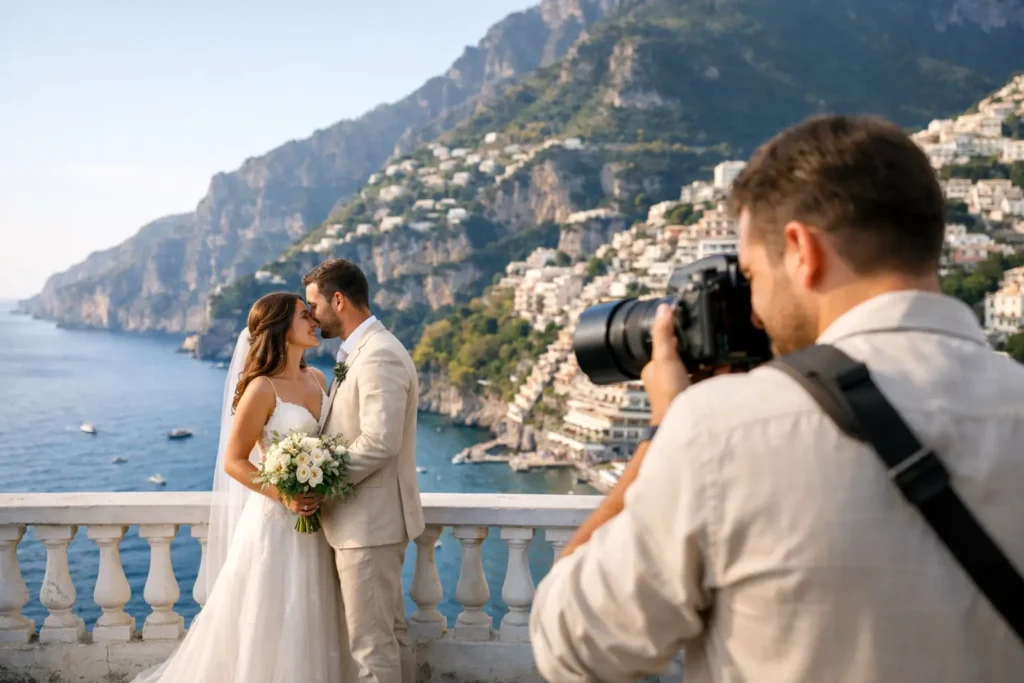
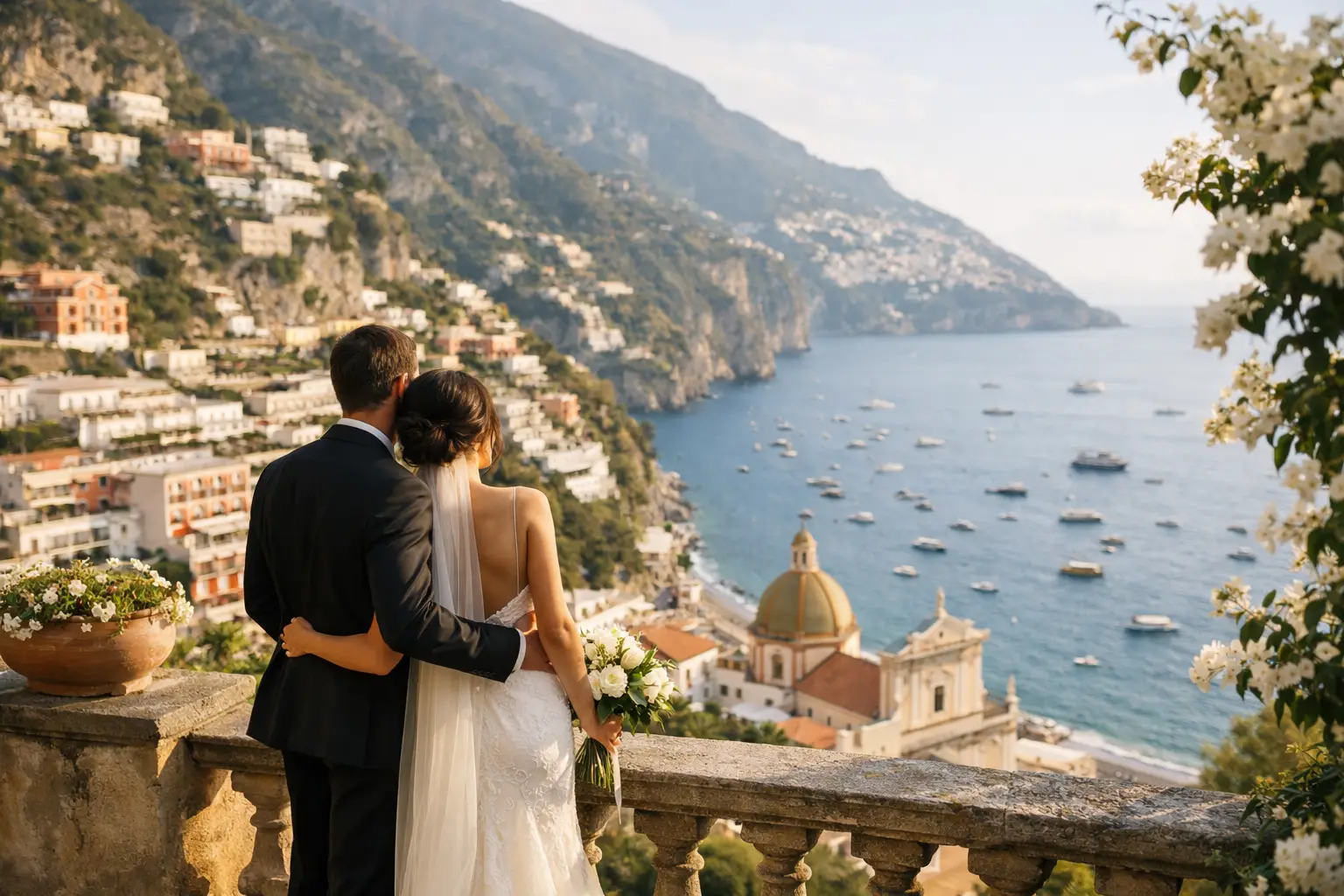
Positano does not offer one backdrop. It offers a sequence of them: tiled stairways opening onto the sea, faded peach façades rising above a white beach, a church dome catching the last light, and private terraces suspended over the coast. The most memorable Positano wedding photo spots are not simply the famous viewpoints. They are the places that suit the pace, light, and emotional texture of your celebration.
For photographs that feel editorial yet alive, location matters less than movement between locations. A wedding day in Positano is often at its most beautiful when there is room to pause, let a veil move in the breeze, take the long way down a lane, and allow the town to become part of the story rather than a backdrop rushed through between events.
Positano Wedding Photo Spots Begin With Timing
Positano is vertical, busy, and shaped by its cliffs. This creates extraordinary visual depth, but it also means light changes quickly and logistics deserve as much attention as aesthetics. A terrace can be brilliant in one hour and fully shaded in the next. A lane that feels quiet during a first look may fill with visitors later in the afternoon.
For this reason, portrait planning should begin with the ceremony time, your getting-ready location, and the season. In high summer, the strongest sun can be unforgiving on open terraces and along the beach. I often prefer to use that part of the day for candid preparation, interiors, shaded architectural details, or time with family. The softer hours before the ceremony or closer to sunset are more forgiving for couple portraits.
A short portrait session can be enough when it is thoughtfully placed. The goal is not to collect every recognizable view of Positano. It is to create photographs with air, intimacy, and a real sense of place while protecting the time you have with the people you traveled to Italy to celebrate with.
Spiaggia Grande and the View Back to Town
Spiaggia Grande is Positano at its most immediately recognizable. From the beach, the town rises in layers behind you, with its cascade of balconies, bougainvillea, and pastel buildings creating a cinematic frame. It is particularly effective for photographs with scale: a bride and groom walking at the waterline, a long veil against the sand, or a quiet moment looking back toward the village.
The trade-off is that this is a public beach and one of the most visited places on the coast. It is rarely empty in the warmer months. Rather than fighting that reality, a documentary approach can use it well. Passing boats, beach umbrellas, and the gentle movement of the town can give photographs a lived-in Mediterranean energy. If you prefer a cleaner, more private feeling, schedule only a brief visit at a quieter hour or choose a boat perspective instead.
The beach is also an excellent transition point. Arriving by sea, or leaving for a short cruise after portraits, changes the visual rhythm of the gallery. From the water, Positano appears as it was meant to be seen: sculptural, bright, and dramatically set between mountain and sea.
The Sea as a Moving Portrait Location
A boat is not simply another scenic option. It offers privacy, open horizons, and a different quality of light reflected from the water. It can be especially valuable for couples who want a few unhurried images away from the attention of the streets.
Wind is part of the experience, so styling should be considered with care. A lightweight veil, relaxed hair, and clothing that moves naturally tend to photograph more beautifully than anything overly fixed or formal. Sea conditions and the timing of the day will always shape what is possible, but the result can carry a quiet, cinematic soul that is distinctly Amalfi Coast.
The Church of Santa Maria Assunta and the Old Lanes
The majolica dome of the Church of Santa Maria Assunta is one of Positano’s defining architectural details. Whether your ceremony takes place nearby or elsewhere in town, the exterior and surrounding streets offer a strong sense of historic Positano without needing elaborate direction.
The best images here are often made in motion. A hand held while descending a narrow stairway, a glance exchanged beneath an arch, or the bride’s dress moving through a passage of worn stone can feel more personal than a posed portrait facing the camera. These lanes compress the frame in a beautiful way, drawing attention to gesture, fabric, and connection.
They also require patience. Steps are uneven, passages can be narrow, and pedestrian traffic is part of the setting. Comfortable shoes for walking between locations, even if only for a few minutes, are a sensible choice. A photographer familiar with the town can guide the route efficiently, selecting corners where the light is softer and the background feels calm without turning the experience into a procession.
Terrace Views That Keep the Celebration Close
Many Positano wedding venues and private residences have terraces that look over the sea or across the town. These spaces are often the most meaningful portrait locations because they hold the atmosphere of the day itself. Your friends may be gathering below, the ceremony flowers may still be in view, and the coastal light becomes part of the celebration rather than a separate excursion.
A terrace works beautifully for a first look, a few composed editorial portraits, or those minutes just after the ceremony when the emotion is still close to the surface. The wide view is valuable, but details matter too: a linen-covered table, lemon leaves, candlelight beginning at blue hour, or a doorway framing the two of you against the water.
Not every terrace receives the same light. Some are open and sun-filled; others are protected by the town’s steep architecture. Before the wedding day, it is worth considering where the sun will sit during the moments you hope to photograph. That small planning decision can make the difference between portraits that feel strained by glare and images with luminous, natural skin tones.
Fornillo and a Quieter Coastal Rhythm
Fornillo offers a softer alternative to the center of Positano. Reached along the coastal pedestrian route, it has a more relaxed rhythm than Spiaggia Grande while still holding the essential character of the village: sea, cliffs, and buildings unfolding above the shore.
It is not always the right choice on a tightly timed wedding day, especially if the ceremony and reception are centered high in town. The walk and changing levels need to be factored into the schedule. But for an elopement, engagement session, or celebration with time for a longer walk, the journey itself can create some of the most natural photographs of the day.
Here, I would focus less on the broad postcard view and more on the in-between moments: the two of you walking side by side, a pause on the path, the coastline receding behind you. These are the frames that give a wedding gallery its breathing room.
How to Make the Locations Feel Like Yours
The most refined Positano photographs do not depend on constantly posing in front of landmarks. They come from choosing two or three settings that reflect the shape of your day, then giving each one enough time. A private terrace may provide intimacy. The old lanes bring texture and movement. The beach or a boat adds scale.
Consider your priorities honestly. If you value time with guests above all else, portraits close to your venue may be the best choice. If the architecture and sea are central to your vision, protect a little more time around the gentler light of late afternoon. If privacy matters, plan a boat session or choose quieter streets rather than relying on the busiest viewpoints.
The same approach applies to an engagement or pre-wedding session. Positano is most generous when it is not hurried. An early walk through the town, followed by time by the water, can produce a collection that feels relaxed, polished, and entirely connected to the place.
For a sense of how Positano’s light, architecture, and human connection can come together across a full celebration, explore the portfolio stories and share the shape of your plans through the inquiry page. The right locations should leave you with more than a view – they should return you to the feeling of being there, together, on the coast.