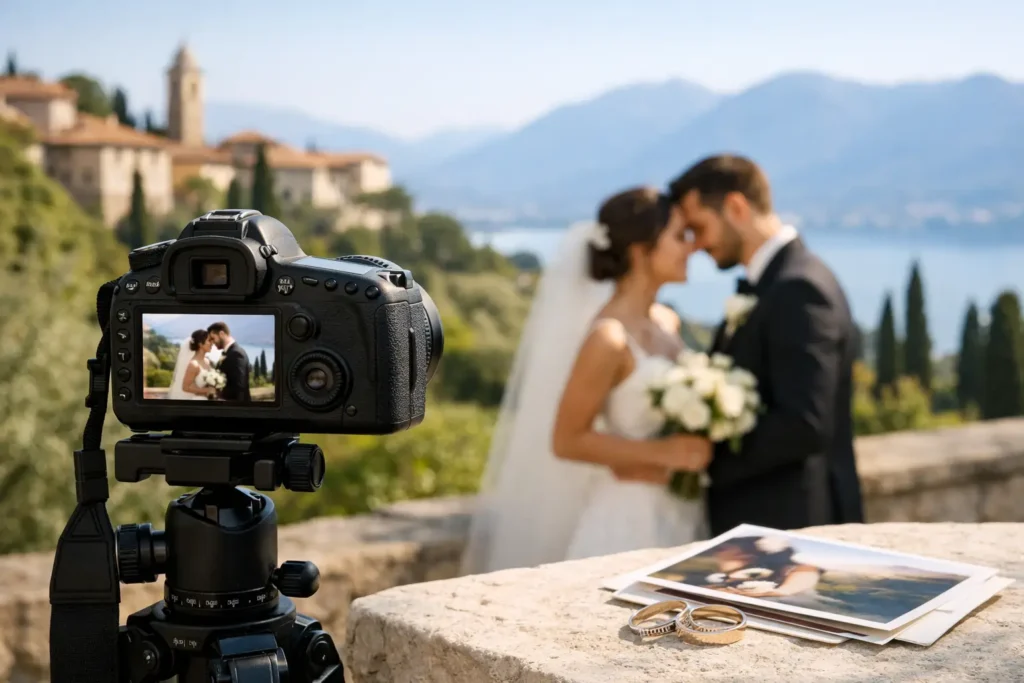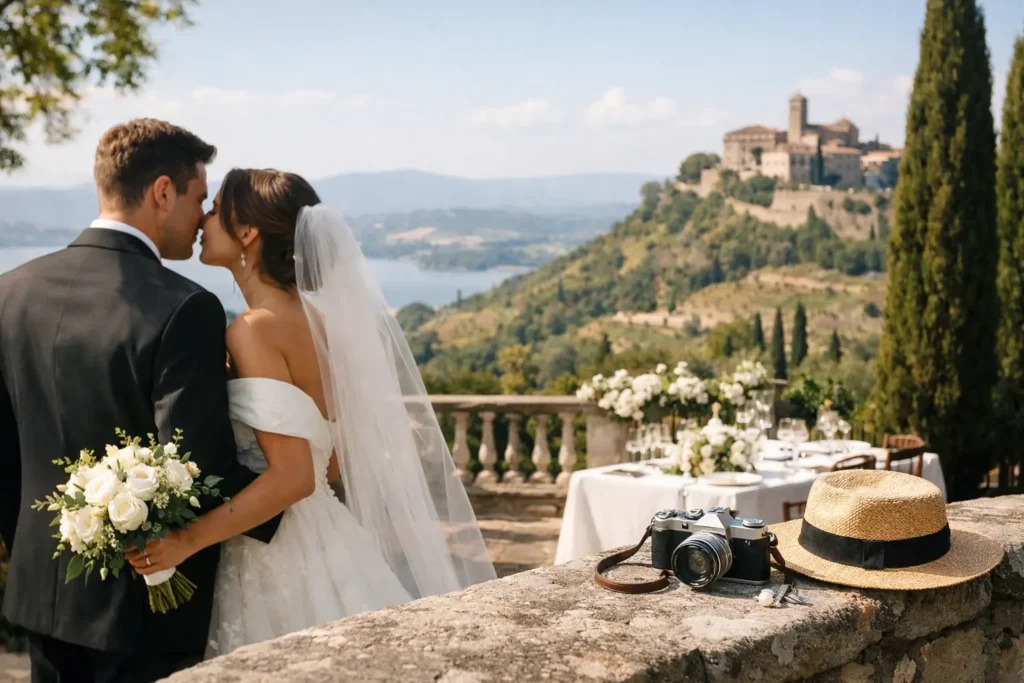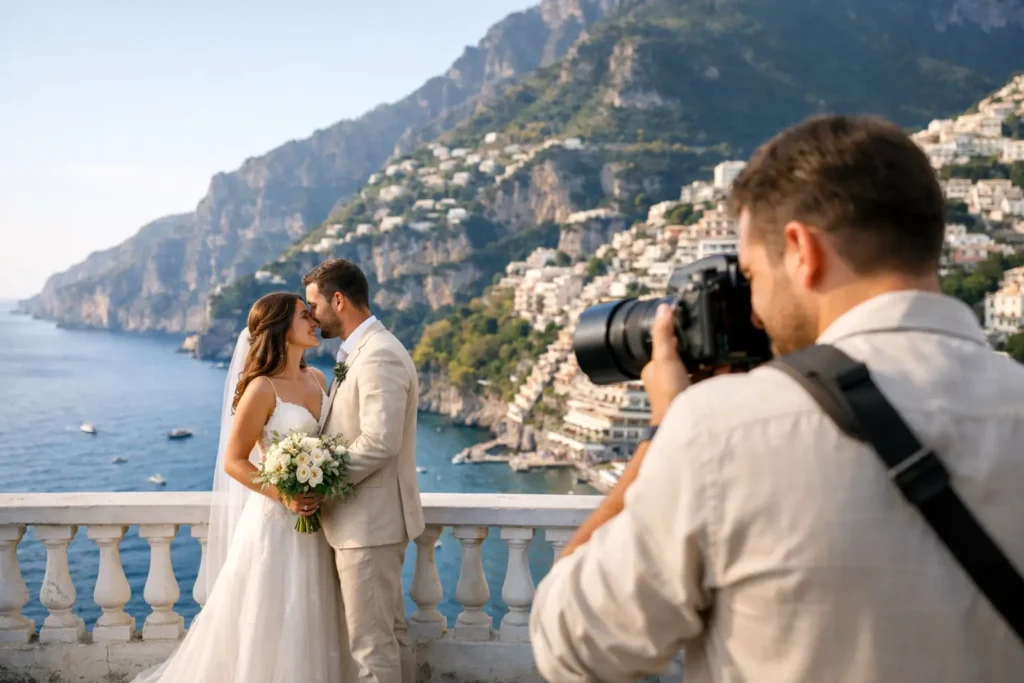
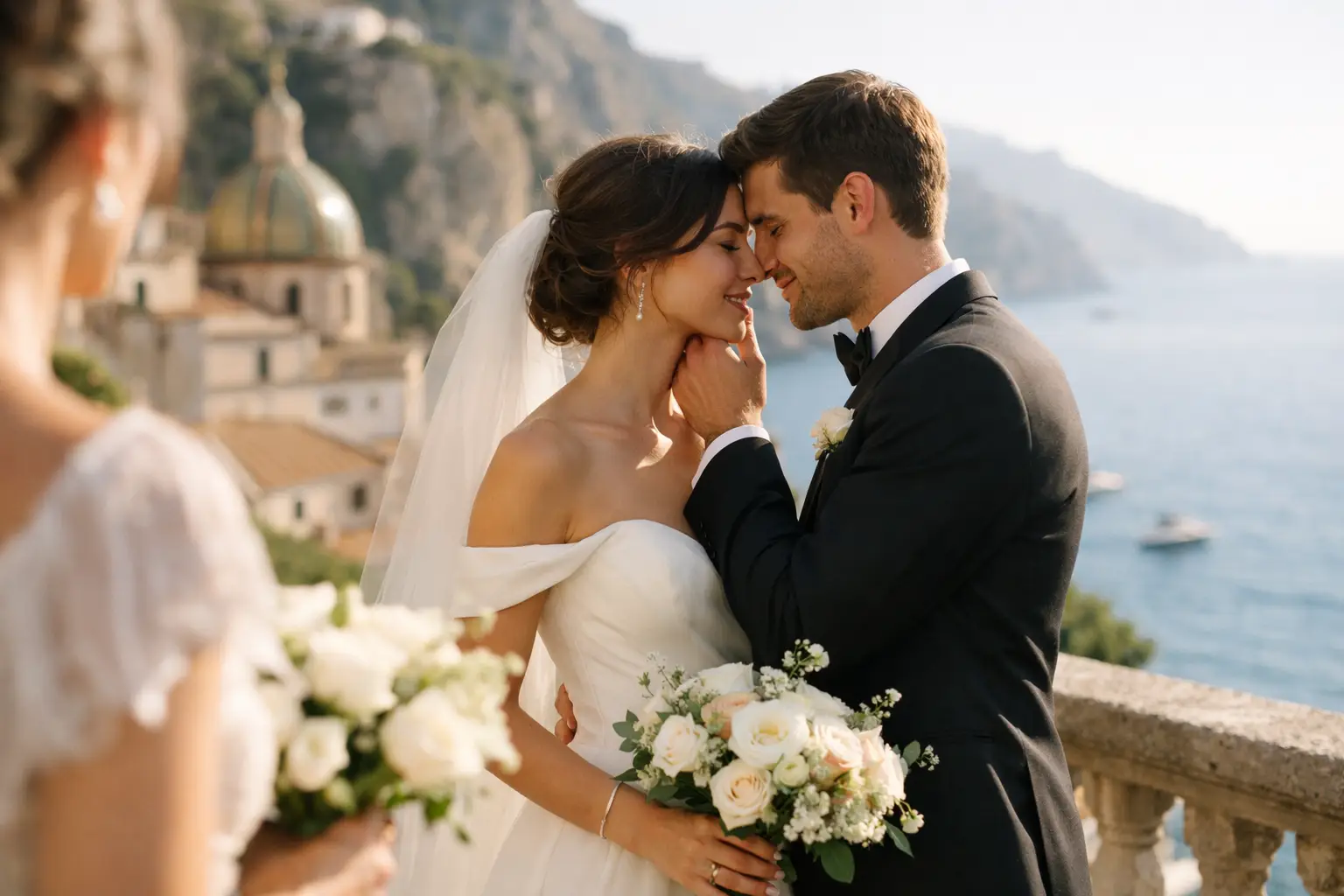
A bride pauses beneath the faded frescoes of a Ravello palazzo while the late-afternoon light shifts from gold to pearl. The photograph needs more than a beautiful dress and a striking setting. Fashion photography wedding influence is what gives that frame its sense of intention: attention to line, texture, light, and presence, while preserving the fleeting emotion that makes the image belong to two real people.
For couples drawn to an editorial visual language, this influence can be deeply appealing. Yet the most compelling wedding photographs do not turn a celebration into a fashion campaign. They use the discipline of fashion photography to elevate what is already there: the sculptural fall of silk, the geometry of a terrace, a groom’s hand finding his partner’s, or a veil lifting in the coastal wind.
What Fashion Photography Brings to a Wedding
Fashion photography teaches a photographer to see with precision. It is an awareness of how a body occupies a space, how fabric responds to movement, and how light can shape mood before a single word is spoken. At a wedding, those instincts are valuable because Italy offers visual richness at every turn, but it also asks for discernment.
A stone staircase in Positano may be visually dramatic, for example, but its beauty is not enough on its own. The relationship between the couple, the angle of the sun, the surrounding activity, and the pace of the day all determine whether an image feels alive rather than simply polished. Editorial influence brings considered composition. Documentary experience ensures that composition still has a pulse.
This is why fashion-led wedding imagery often feels refined without appearing stiff. The goal is not to ask a couple to perform a version of romance for the camera. It is to offer calm, clear direction when it helps, then leave room for the unscripted gestures that cannot be repeated.
Fashion Photography Wedding Influence Without the Stiff Poses
The concern many couples have is understandable: will editorial photographs feel overly posed? They can, if visual perfection becomes more important than comfort. A fashion background is most effective when it informs the photographer’s eye, not when it dictates every second of the wedding day.
During portraits, subtle adjustments can make a remarkable difference. A slight turn toward the light, a relaxed shoulder, an invitation to walk rather than stand still, or a moment of quiet conversation can create shape without creating tension. The couple still looks like themselves, only seen with greater attention.
That approach matters particularly for people who are not accustomed to being photographed. Most do not need a long list of poses. They need to feel at ease, understand where to place themselves, and trust that the photographer is watching the details. When the direction is gentle and specific, the result is natural confidence rather than self-consciousness.
The balance also changes throughout the day. There is space for more composed imagery when the wedding attire is fresh and the light is favorable. Later, during greetings, dinner, and dancing, the camera should become quieter. An elegant wedding story needs the portrait of a bride in architectural shadow, but it also needs her laughter as she reaches for a friend across the table.
Why the Amalfi Coast Rewards an Editorial Eye
The Amalfi Coast is not a neutral backdrop. Its vertical villages, narrow passages, tiled terraces, and brilliant water create strong visual elements that can either enrich a photograph or overpower it. A practiced editorial eye recognizes when the landscape should lead and when it should recede.
In Positano, the layers of houses climbing the hillside can create extraordinary depth, especially in the early morning or as the day softens toward evening. But bright midday sun can be severe, and popular streets move quickly. Portrait planning here is less about chasing a checklist of locations and more about choosing a short, thoughtful route with light, privacy, and time in mind.
Ravello offers another visual register. Its gardens, historic architecture, and elevated views invite a more composed, cinematic use of space. The light can move rapidly across a terrace, particularly when clouds cross the coast, so an experienced photographer is always reading the conditions rather than forcing a predetermined image.
Along the Sorrento Coast, and further south on the Cilento Coast around Castellabate, the atmosphere can feel more spacious and unhurried. Warm limestone, old town lanes, and the open horizon offer a quieter frame for story-driven portraits. These locations still demand local awareness: steep streets, uneven ground, changing sea breezes, and the realities of moving a wedding party through historic places all affect timing.
The Difference Between Editorial and Performative
Editorial does not mean extravagant. It does not require a dramatic gown, a vast floral installation, or a day organized around constant photography. The most lasting images often come from restraint.
A simple black-tie dinner on a candlelit terrace can feel deeply editorial when photographed with sensitivity to atmosphere. So can an intimate elopement in Amalfi, where the focus is less on scale and more on the way the couple moves through the town together. The visual language should respond to the wedding, not impose a style that does not belong there.
This is also where honest documentary photography becomes essential. A wedding has its own rhythms: anticipation while getting ready, family emotion during the ceremony, the release of celebration after dinner. If the photographer is too focused on producing a sequence of perfect frames, those rhythms can be interrupted. If the photographer is too hands-off, the portrait time may lack the intentionality that couples value.
The strongest work sits between those extremes. It feels edited in its visual point of view, but never edited out of life.
Light, Movement, and the Details That Hold a Story
Fashion imagery often gives equal importance to the smallest visual details: the texture of a jacket, the sheen of a shoe, the placement of a hand, or the curve of a table set for dinner. At a wedding, these details have emotional weight because they are part of a larger narrative.
A fine-art invitation resting against hand-painted ceramics may be beautiful, but it is not photographed merely as decoration. It belongs to the opening pages of the story. The movement of a gown through a hotel corridor, the salt air caught in a veil, or the warm color of candlelight against old plaster can become transitions between the larger moments of the day.
Light is the thread that connects them. Southern Italian light can be crisp and reflective near the sea, soft beneath an arcade, and intensely warm at sunset. Rather than treating every condition as the same, a photographer with editorial experience uses each one deliberately. Direct sunlight may suit a confident, graphic portrait. Open shade may be more flattering and intimate for a private exchange. After dark, the ambient glow of a dinner space can preserve the feeling of the evening far better than flattening it with intrusive light.
Choosing This Style for Your Wedding
If you are considering a photographer with a fashion background, look beyond a few dramatic portraits. Look for consistency across an entire wedding day. Do the images hold emotional closeness as well as visual polish? Are families and guests photographed with the same care as the couple? Does the work feel connected to the location without relying on scenery alone?
It is also useful to ask how portrait time is approached. For some couples, a short, carefully planned session is ideal. Others want more time for editorial couple portraits, perhaps around a pre-wedding session when there is no schedule to protect. Neither choice is better. It depends on how you want to experience the day and what role photography should play within it.
At Gennaro Piscopo Photography, the fashion-photography foundation is paired with an unobtrusive documentary approach shaped by more than two decades behind the camera. The intention is never to make a wedding feel like a production. It is to create photographs with clarity, soul, and a lasting sense of place.
As you browse a photographer’s portfolio, pay attention to the images that make you pause. Not only the grand coastal view or the impeccably framed portrait, but the quieter photograph that lets you feel the air, the light, and the connection between two people. That is where editorial influence becomes something more personal: a record of a celebration that looks beautiful because it felt real.